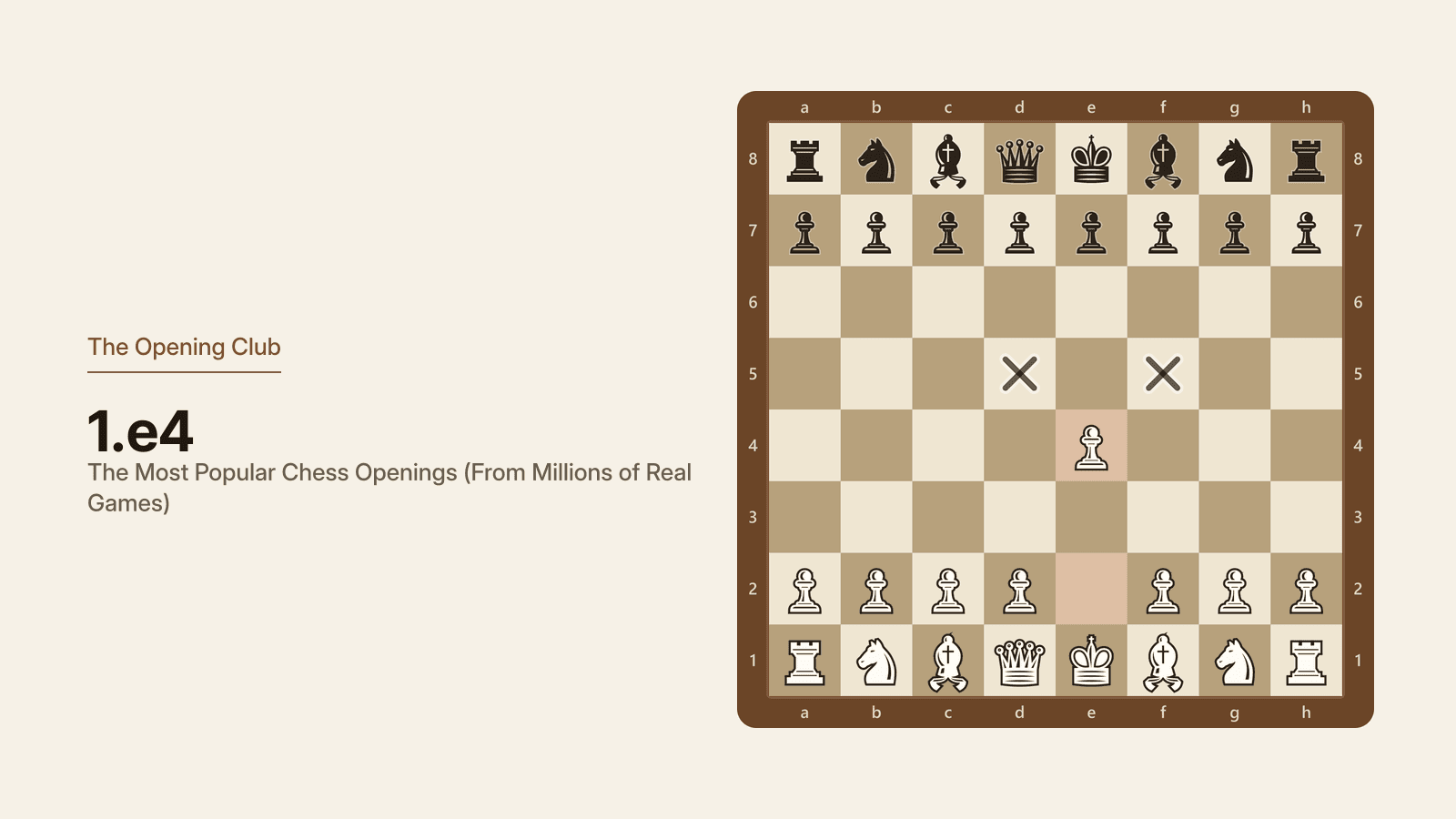
The most popular chess openings are the ones players actually reach, which is not the same list as the ones books recommend. Across Lichess rapid and blitz games, 1.e4 opens between 59.7% and 66.8% of games depending on rating band, 1.d4 between 19.6% and 26.5%, and the other twelve tracked first moves split what is left.
That is the whole subject in three numbers, and the interesting part is what happens underneath them: which openings amateurs pick, how those picks change as ratings rise, and how far the popular choices sit from the good ones.
All figures below come from the Lichess open database, May 2026, rapid and blitz, split into four rating bands: 600, 1000, 1400 and 1800. Those are Lichess bucket lower bounds, not midpoints. There is no 800 or 1200 band.
How popularity is measured, and the trap in it
A popularity share here is the percentage of that band's games that reached the position. That definition contains a trap that most published opening statistics fall straight into.
The shares are nested. You cannot add them up.
At the 1000 band: 1.e4 is 65.95% of games. 1.e4 e5 is 36.11%. 1.e4 e5 2.Nf3 is 22.59%. Those are not three separate slices of a pie. Every 1.e4 e5 2.Nf3 game is also a 1.e4 e5 game and also a 1.e4 game. Adding them gives 124.65%, which should tell you immediately that something is wrong.
Only the first-move rows form a disjoint set that sums to 100%. Below that, always compare like for like: second moves against second moves, third moves against third moves. If you see an article listing "the top 10 openings" with shares that include both 1.e4 e5 and the Italian Game, it has double counted, and every conclusion downstream of that is suspect.
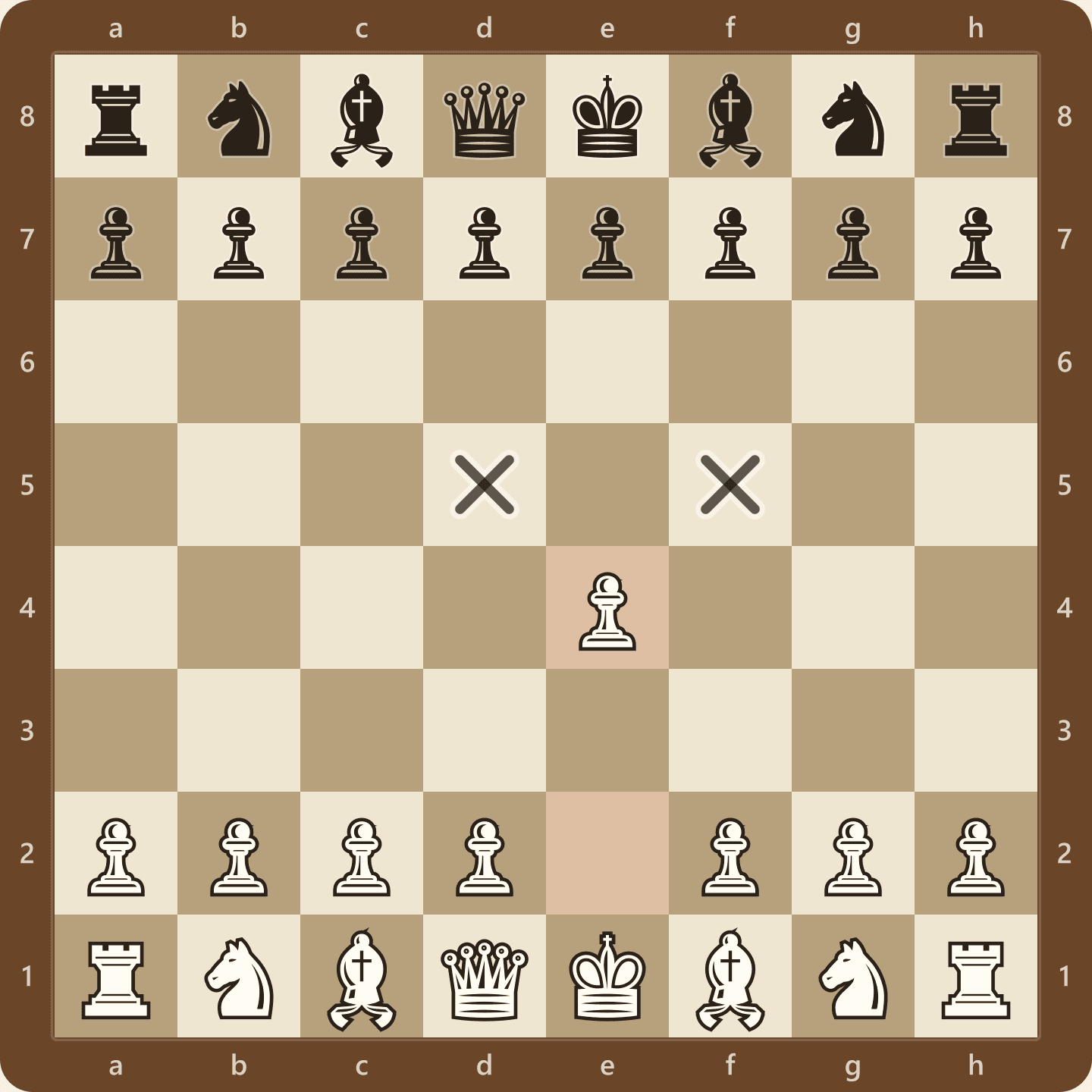
The most popular first moves
| First move (share of that band's games) | 600 band | 1000 band | 1400 band | 1800 band |
|---|---|---|---|---|
| 1.e4 | 66.82% | 65.95% | 63.49% | 59.74% |
| 1.d4 | 19.61% | 22.41% | 24.37% | 26.52% |
| 1.c4 (English Opening) | 1.34% | 1.87% | 2.52% | 3.54% |
| 1.Nf3 (Reti and Zukertort move orders) | 2.69% | 2.38% | 2.43% | 3.08% |
| 1.e3 | 3.00% | 2.05% | 1.63% | 1.21% |
| 1.f4 (Bird's Opening) | 0.71% | 0.74% | 0.91% | 1.29% |
| 1.b3 (Nimzo-Larsen Attack) | 0.59% | 0.83% | 1.09% | 1.11% |
| 1.g3 | 0.98% | 1.08% | 1.17% | 1.14% |
| 1.f3 (Barnes Opening) | 0.16% | 0.08% | 0.06% | 0.06% |
Sample sizes: 4,206,514 games in the 600 band, 14,075,034 at 1000, 10,678,582 at 1400 and 20,823,049 at 1800, counting the 14 tracked first moves.
The trend is a slow, steady migration away from 1.e4. It loses seven points of share between 600 and 1800, and 1.d4 picks up most of it. That is not because 1.e4 is bad; it scores 49.06% to 50.18% for White depending on band, which is fine. It is because 1.e4 is what you play when nobody has told you about anything else, and 1.d4 is what a lot of players switch to once somebody has.
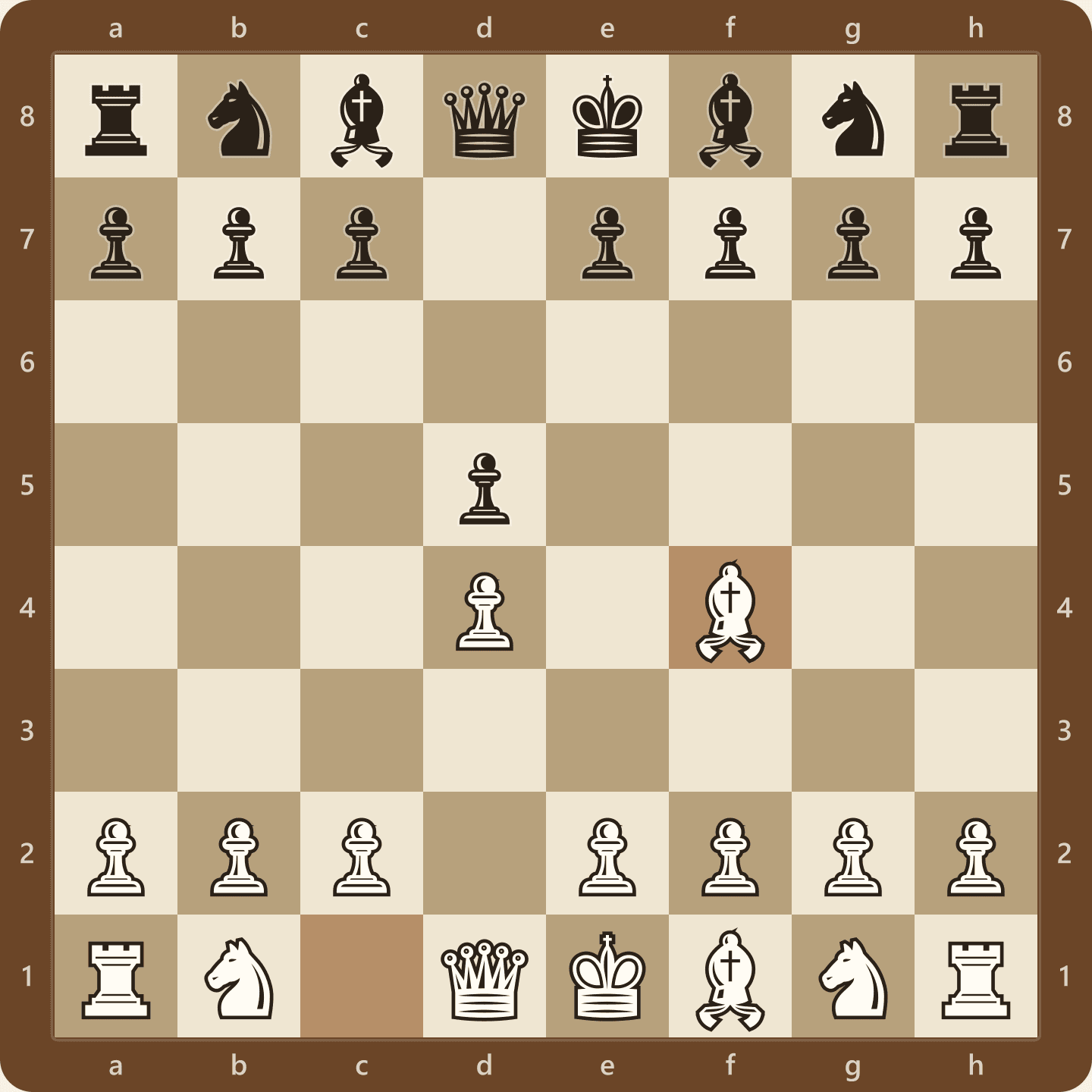
The most popular second moves
Comparing like for like, here are the most-reached positions after two moves each.
| Position (share of that band's games) | 600 band | 1000 band | 1400 band | 1800 band |
|---|---|---|---|---|
| 1.e4 e5 2.Nf3 (King's Knight Opening) | 22.29% | 22.59% | 18.44% | 13.16% |
| 1.e4 c5 2.Nf3 (Open Sicilian move order) | 1.04% | 2.72% | 4.34% | 6.61% |
| 1.e4 e5 2.Bc4 (Bishop's Opening) | 5.35% | 4.11% | 3.59% | 2.14% |
| 1.d4 d5 2.c4 (Queen's Gambit) | 1.81% | 3.22% | 3.87% | 4.36% |
| 1.e4 e6 2.d4 (French Defense main line) | 1.39% | 2.18% | 2.75% | 3.52% |
| 1.e4 c6 2.d4 (Caro-Kann main line) | 0.97% | 1.83% | 2.29% | 3.02% |
| 1.d4 d5 2.Bf4 (London System) | 2.34% | 3.10% | 2.78% | 2.12% |
| 1.d4 Nf6 2.c4 (Indian Defense main line) | 0.21% | 0.62% | 1.13% | 2.32% |
| 1.e4 e5 2.Nc3 (Vienna Game) | 2.69% | 2.35% | 2.14% | 1.55% |
| 1.e4 e5 2.d4 (Center Game) | 2.62% | 2.33% | 1.78% | 1.33% |
| 1.e4 e5 2.f4 (King's Gambit) | 0.64% | 1.16% | 1.70% | 1.91% |
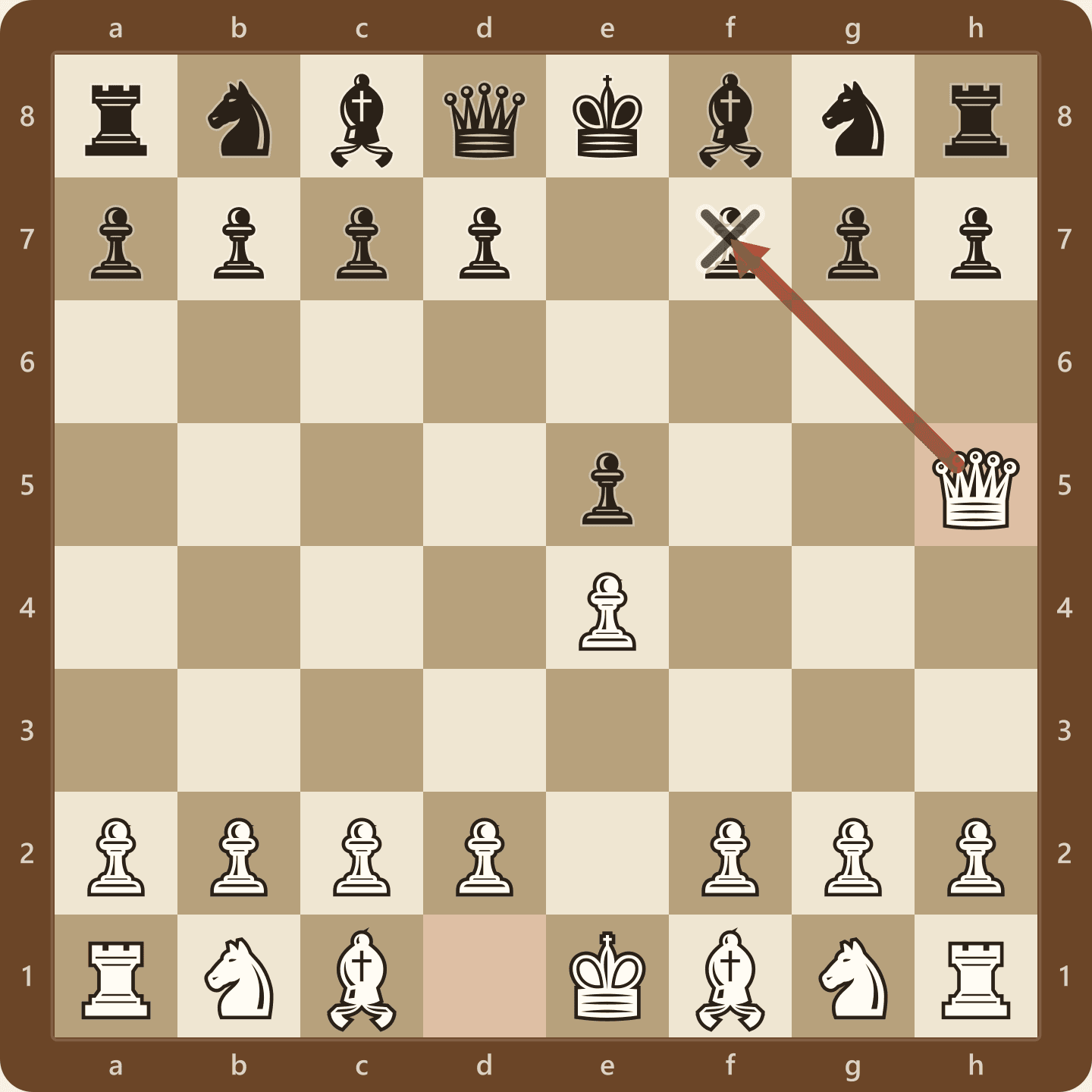
| 1.e4 e5 2.Qh5 (Wayward Queen Attack) | 3.81% | 1.13% | 0.37% | 0.13% |
The last row is the single most dramatic number in this dataset. 2.Qh5, the Scholar's Mate attempt, appears in 3.81% of games in the 600 band and 0.13% in the 1800 band. That is a thirtyfold collapse, steeper than anything else here. It is the clearest visible trace in the data of players learning something.
Popular is not the same as good
This is the part worth the reader's time, because it is where the popularity data earns its keep.
The most popular defense is the worst-scoring mainstream defense. 1.e4 e5 is Black's most common reply at every band: 41.63% of all games at 600, still 21.09% at 1800. Black wins 44.67% to 45.40% of those games depending on band, the lowest figure of any major reply to 1.e4. The Sicilian, at 3.06% of games in the 600 band, gives Black 48.82%.
The Sicilian Defense and popularity move together as players improve. Its share quadruples from 3.06% at 600 to 12.48% at 1800, and it is the best-scoring Black reply throughout. This is the one case where the crowd and the numbers agree, eventually.
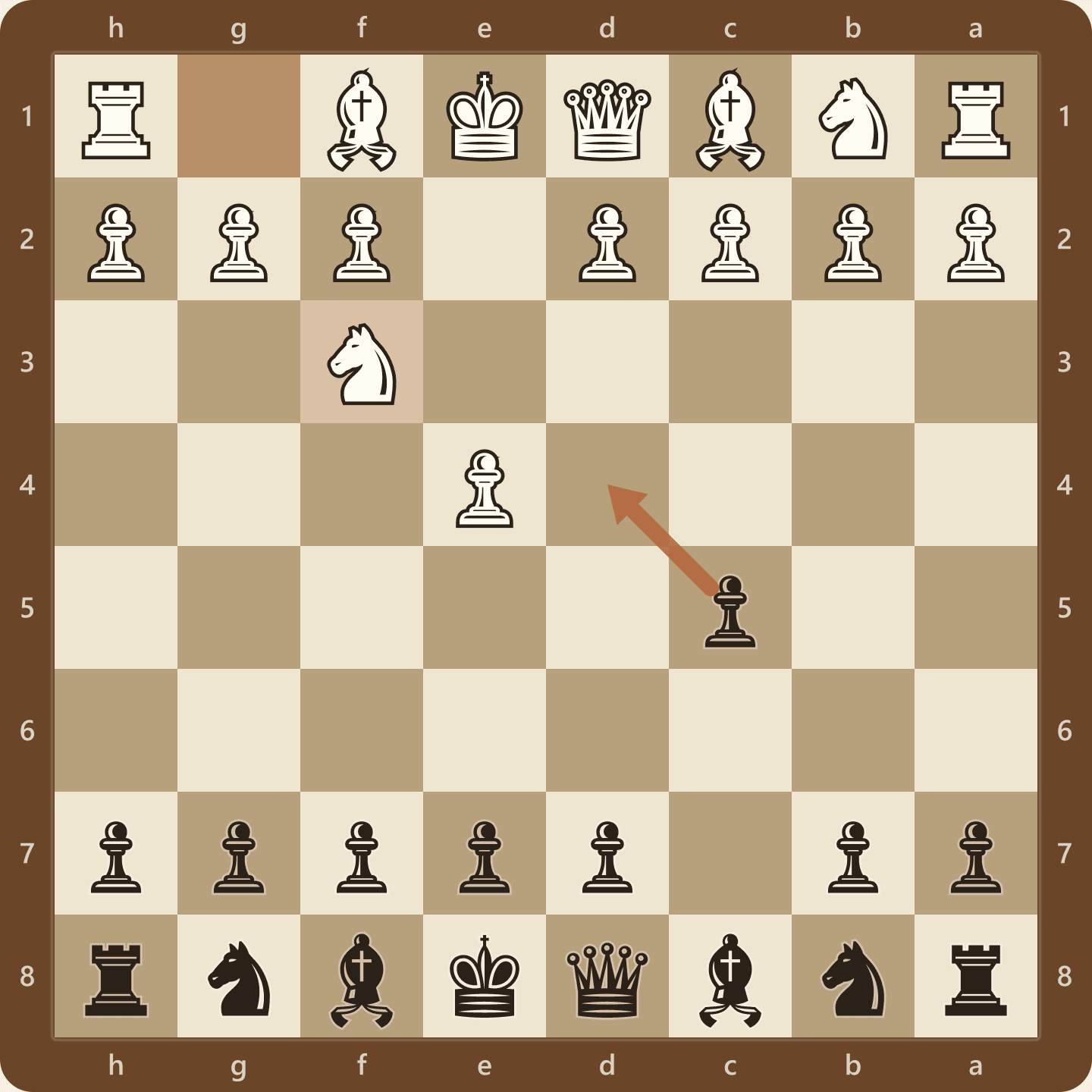
The Italian Game is more popular than the Ruy Lopez at every band, and scores lower at every band. Italian: 5.10% at 600, 6.81% at 1000, 5.61% at 1400, 3.99% at 1800, with White scoring 51.96%, 50.89%, 50.30% and 49.83%. Ruy Lopez: 1.52%, 2.61%, 2.34% and 1.95% of games, with White scoring 51.67%, 51.62%, 51.34% and 51.35%. The Ruy Lopez is played roughly a third as often and holds its score flat while the Italian decays.
The Bishop's Opening is a 600-band phenomenon. 1.e4 e5 2.Bc4 is played in 5.35% of games at the 600 band, three and a half times more often than the Ruy Lopez, and produces 50.89% for White against the Ruy Lopez's 51.67%. Everyone at that level plays Bc4 because it points at f7, and it is not the best square for the bishop.
Scholar's Mate does not pay. 2.Qh5 scores 50.33% for White in the 600 band. Playing 2.Nf3 instead scores 52.06%. The early queen sortie gives up nearly two points of win rate for the chance at a four-move mate, and even in the band where it works best it is a losing trade.
What rises and what falls with rating
Sorted by direction of travel between the 600 and 1800 bands:
Rising sharply: the Sicilian Defense (3.06% to 12.48%), the Indian Defense with 1...Nf6 (1.42% to 5.53%), the Caro-Kann Defense (2.98% to 5.96%), the French Defense (3.82% to 6.48%), the Queen's Gambit (1.81% to 4.36%), the English Opening (1.34% to 3.54%) and the King's Gambit (0.64% to 1.91%).
Falling sharply: 1.e4 e5 (41.63% to 21.09%), the Wayward Queen Attack (3.81% to 0.13%), the Bishop's Opening (5.35% to 2.14%), Alekhine's Defense (1.69% to 0.86%), the Center Game (2.62% to 1.33%) and 1.e3 (3.00% to 1.21%).
Roughly flat: the Scandinavian Defense (7.18% to 5.90%), 1.d4 d5 (10.72% to 11.18%), the Pirc Defense (2.11% to 2.50%) and the London System with 2.Bf4 (2.34% to 2.12%).
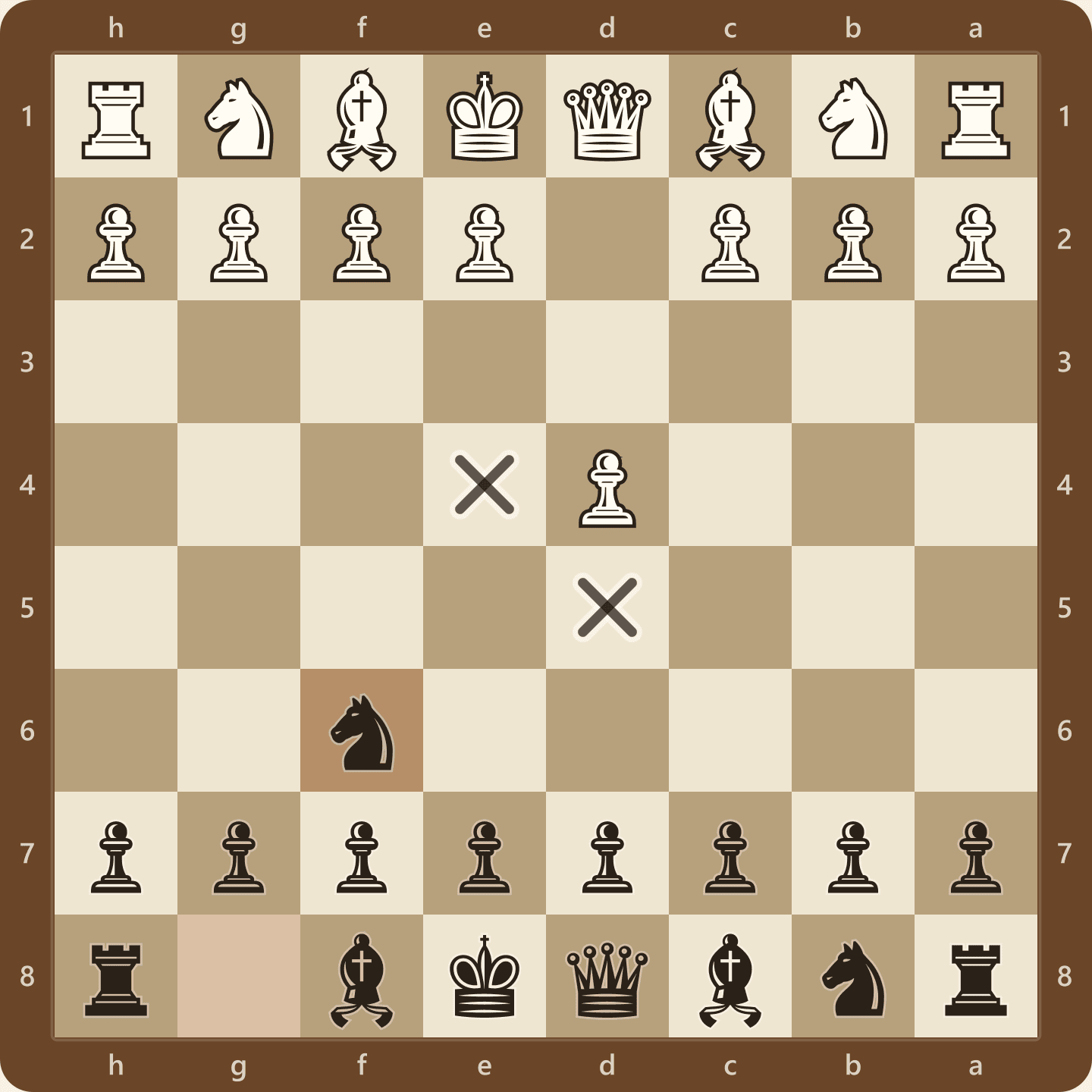
The pattern across all three lists: openings that ask you to fight for the centre indirectly, hypermodern openings in the old terminology, gain share as players improve. Openings that put a piece on an aggressive-looking square and hope lose it.
What this data does not show you
- No master games. Nothing above the 1800 band is here, so this page cannot tell you what grandmasters play. At that level the answers are different, and the Catalan Opening, the Grünfeld Defense and the Nimzo-Indian Defense are far more prominent than they are down here. The Nimzo-Indian appears in 0.01% of 600-band games and 0.30% at 1800.
- Not every opening is tracked. The set is 314 lines. The Catalan, the Grünfeld, the Evans Gambit and the Benko Gambit have no rows at all, so no share is published for them anywhere on this page.
- Rapid and blitz, one month. A May 2026 export from one site. Popularity in particular moves with whatever the big chess channels covered recently, faster than any other figure here.
- Some openings are thin at the bottom. The King's Indian Defense has 1,551 games in the 600 band against 124,899 at 1800. The Slav Defense runs from 0.23% of games at the 600 band to 1.32% at 1800, and the Dutch Defense never passes 0.66% in any band. The Reti Opening sits inside the 1.Nf3 total, which itself never exceeds 3.08%.
So which should you actually play?
Popularity is useful for exactly one decision: what you will face. If you play 1.e4 in the 600 band, 41.63% of your games will be 1.e4 e5 and 7.18% will be the Scandinavian, so those are the two positions worth knowing. The Sicilian will show up in one game in thirty-three, and preparing an anti-Sicilian system before you can handle 1.e4 e5 is a misallocation.
For choosing your own repertoire, popularity is close to useless and results are what matter. The classic principles still carry more weight below 1800 than any specific line: take the centre, develop pieces rather than pushing pawns, get the king castled, and do not bring the queen out on move two. Chess opening principles covers those properly, and how much opening theory do you actually need covers the memorisation question.
The results side of this data, with sample sizes on every figure, is chess opening win rates. The graded version, per band and per colour, is the chess opening tier list. How often people throw games away in these openings is blunder rate by rating. To pull any of these numbers yourself, how to use a chess opening explorer walks through it, and the map of the whole subject is chess openings.
Frequently asked questions
What are the most popular chess openings for White?
1.e4 by a wide margin, in 59.74% to 66.82% of games depending on rating band. Then 1.d4 (19.61% to 26.52%), 1.Nf3 (2.38% to 3.08%) and the English Opening with 1.c4 (1.34% to 3.54%). After two moves, the most reached position in every band is 1.e4 e5 2.Nf3, at 22.29% of all games in the 600 band and 13.16% at 1800.
What are the best chess openings for Black?
By popularity, 1...e5 is the most common reply to 1.e4 at every band, followed by the Scandinavian and the Sicilian. By results, that order roughly inverts: the Sicilian gives Black 47.59% to 49.12% and the Caro-Kann 47.48% to 49.06%, against 44.67% to 45.40% for 1...e5. The Sicilian is the only defense that is both popular and high-scoring, and only at the higher bands.
What are the best chess openings for beginners?
The 600-band data says a beginner will face 1.e4 e5 in 41.63% of their games and the Scandinavian in 7.18%, so learning those two positions covers half of everything. As White, 1.e4 e5 2.Nf3 scores 52.06% and is both the most common and the most reliable choice, well ahead of 2.Bc4 (50.89%) and 2.Qh5 (50.33%), which are the two moves beginners actually reach for.
What openings do grandmasters use?
This dataset covers Lichess players rated 600 to 1800 in rapid and blitz, so it cannot answer that. What it can show is the direction of travel: the Sicilian, the Indian Defenses, the Queen's Gambit and the English all gain share steadily as ratings rise, and 1...e5, the Bishop's Opening and the early queen attacks all lose it. Extend those trends and you get most of the way to a master repertoire.
What was Bobby Fischer's favourite opening?
Fischer is famous for "1.e4, best by test", for the Ruy Lopez as White and for the Najdorf Sicilian as Black. Two of those three are unpopular choices in this data: the Ruy Lopez appears in 1.52% to 2.61% of games and the Najdorf in under 0.34% of games in every band, down to 0.005% at the 600 band. Both score well anyway. Magnus Carlsen, by contrast, is known for having no signature opening at all, which is a deliberate anti-preparation strategy rather than a recommendation.
Why do the popularity percentages add up to more than 100?
Because the positions are nested. A share here is the percentage of that band's games that reached the position, and a game passes through several tracked positions on its way. At the 1000 band, 1.e4 is 65.95%, 1.e4 e5 is 36.11% and 1.e4 e5 2.Nf3 is 22.59%, and the second and third are subsets of the first. Only the first-move rows are disjoint and sum to 100%.