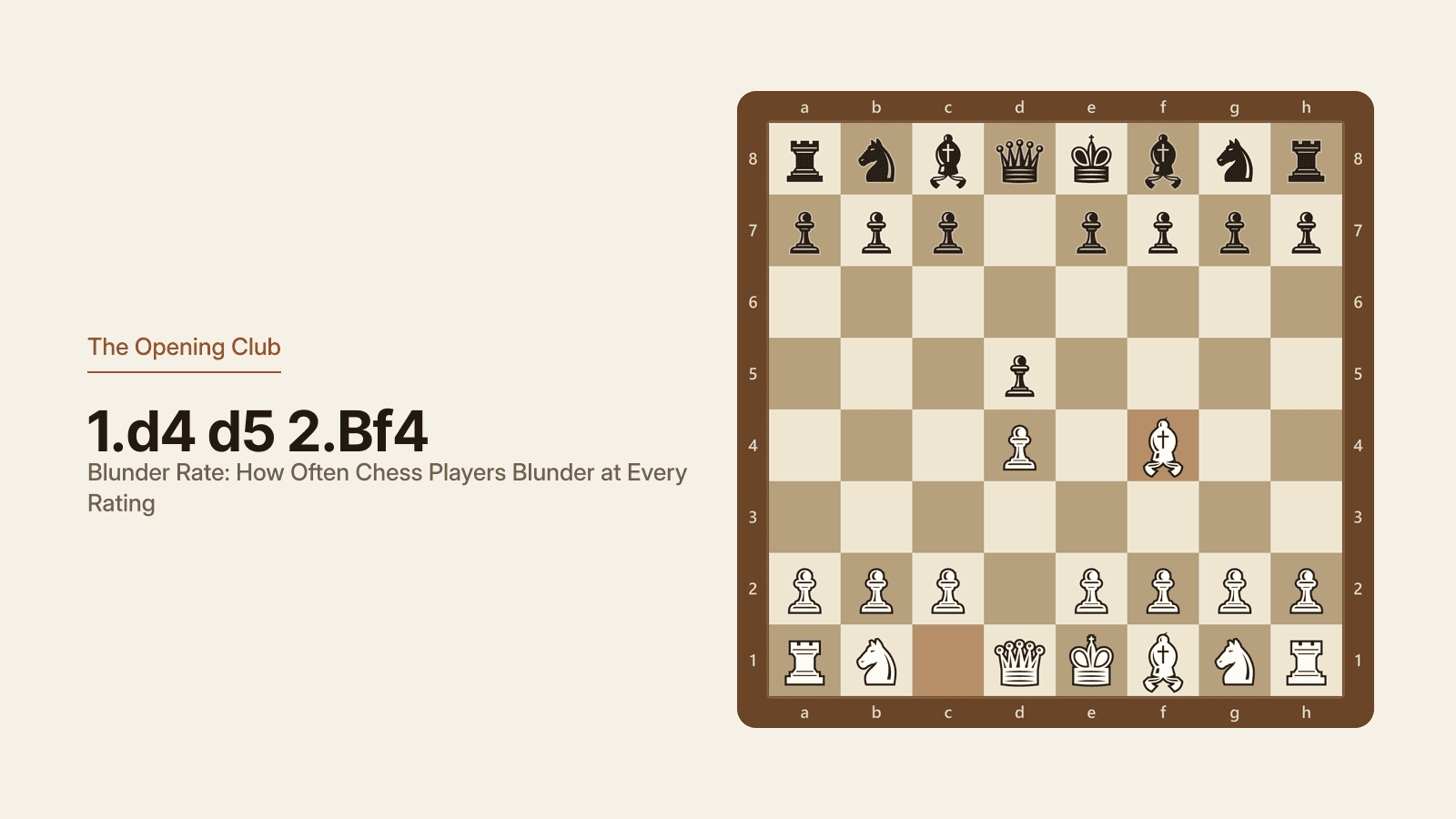
Blunder rate is the share of games in which a player makes a blunder, a move that throws away material or the game outright. Measured across 97,740 Lichess rapid and blitz games, the blunder rate in chess falls from 44.8% of games in the 600 rating band to 36.9% in the 1800 band. It never gets close to zero.
That is the headline, and the rest of this page is about how the number was produced, because a metric with no method behind it is just a mood.
The numbers
| Rating band | Blunder rate | Trap hit rate | Average book exit ply | Games sampled |
|---|---|---|---|---|
| 600 | 44.8% | 0.47% | 3.30 | 8,099 |
| 1000 | 44.8% | 0.45% | 3.68 | 27,898 |
| 1400 | 41.0% | 0.31% | 3.73 | 21,300 |
| 1800 | 36.9% | 0.23% | 3.81 | 40,443 |
Source: Lichess rapid and blitz games, July 2026, methodology version mat-swing-v1. Each figure is weighted by games, not averaged across opening lines. More on why that distinction matters below.
Three things in that table are worth stopping on.
The 600 and 1000 bands are tied. 44.81% and 44.83%. Improving from a 600 rating to a 1000 rating does not measurably reduce how often you blunder in the opening. What changes first is presumably what you do after the blunder, not whether you make it. The drop only starts between 1000 and 1400.
The fall is real but small. Roughly eight points across a 1,200-point rating span. If you are 1000 and picturing 1800 as a place where people stop hanging pieces, this data says they hang pieces in more than a third of their games.
Book exit gets later, barely. The average game leaves the tracked opening book at ply 3.30 in the 600 band and 3.81 in the 1800 band. A ply is a single move by one side, so ply 3.8 is White's second move. Even at 1800, the typical rapid or blitz game is out of anything you could call theory before move three.
What mat-swing-v1 actually measures, and what it does not
This is a material-swing proxy, not an engine evaluation.
The gold-standard way to detect a blunder is to run every move through a chess engine, Stockfish today or something like Crafty in older studies, and flag any move where the evaluation drops past a threshold. That catches positional catastrophes, missed mates, and moves that lose nothing material but lose the game. It also costs an enormous amount of compute for a 100,000-game sample.
mat-swing-v1 instead watches the material balance in the opening phase of each game and flags a game when it swings the way a blunder makes it swing. It is cheap, it is reproducible, and it is wrong in specific, predictable ways:
- It over-counts sacrifices. A gambit is a deliberate material investment, and this method cannot tell a gambit from a giveaway. Openings where somebody sheds a pawn on purpose will read as blunder-heavy.
- It under-counts positional blunders. Trapping your own bishop, wrecking your king's pawn cover, or walking into a bind loses the game without losing material immediately, and none of that registers.
- It under-counts missed wins. Failing to see a mate in two is arguably the worst blunder there is, and no material changed hands.
- It is a per-game flag, not a per-move count. The figure is the share of games containing at least one qualifying swing, not blunders per game. A game with four blunders counts once.
So read 44.8% as "roughly this share of games in the 600 band contain an opening-phase material accident", not as an engine's verdict. It is a floor for a thing, not the thing.
Why this sample is much smaller than the win-rate sample
The chess opening win rates page on this site covers about 50.1 million games. This page covers 97,740. Those numbers are not interchangeable, and borrowing the bigger one to make this page sound more authoritative would be dishonest.
They also come from different months. The win-rate data is a May 2026 export; the blunder data is July 2026. And they are built differently: the win-rate rows are nested (a 1.e4 e5 game also counts inside 1.e4), while the blunder rows are disjoint, with every game assigned to exactly one opening line. That is why the blunder games column can be added up honestly and the win-rate one cannot.
What 97,740 games buys you is a solid band-level figure. What it does not buy you is the ability to rank openings by blunder rate, which brings us to the awkward part.
The per-opening numbers are mostly too thin to publish
Spread 97,740 games across roughly 300 opening lines and four rating bands, and the median cell holds a few dozen games. The largest single cell in the entire dataset is 1,050 games. A blunder rate measured on 1,050 games carries a margin of roughly plus or minus three points at 95% confidence. On the more typical 40-game cell, the margin is around plus or minus fifteen points, which is wider than the entire spread between the best and worst opening.
Here are the only lines with a sample worth quoting at all, and even these deserve the error bars:
| Opening line | Band | Blunder rate | Games |
|---|---|---|---|
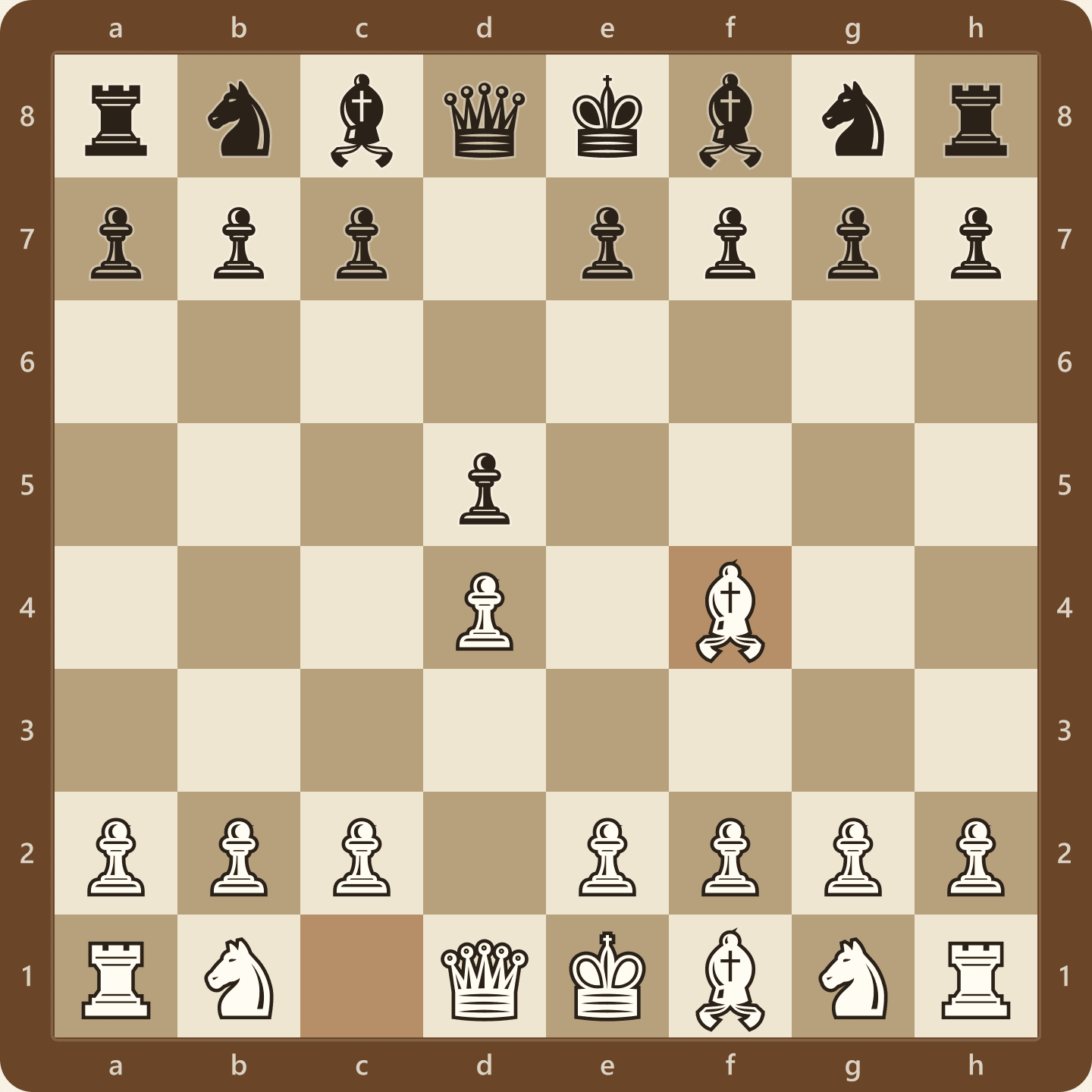
| 1.d4 d5 2.Bf4 (accelerated London) | 1000 | 56.5% | 1,050 |
| 1.d4 d5 2.Bf4 (accelerated London) | 1800 | 55.5% | 1,028 |
| 1.e4 c6 (Caro-Kann) | 1800 | 34.0% | 978 |
| 1.d4 e6 (Horwitz Defense) | 1800 | 29.0% | 1,046 |
| 1.e4 d5 (Scandinavian) | 1000 | 41.6% | 733 |
| 1.e4 e6 2.Nf3 (French, Knight Variation) | 1800 | 30.1% | 672 |
The London System showing up at the top of that list at every band is the most interesting thing in the whole blunder dataset, and it is also the claim this page is least willing to commit to. The move order 1.d4 d5 2.Bf4 posts a blunder rate above 55% in three of four bands, which would be a genuinely funny result for the opening people play specifically to avoid trouble. But a thousand games is a thousand games, and a material-swing proxy is a proxy. Treat it as a lead worth chasing, not a finding.
Trap hit rate, and the strangest number here
Trap hit rate is the share of games that reached one of 25 catalogued trap positions. Across all 97,740 games, about 320 did. That is roughly one game in 300.
Read at the band level, traps are close to irrelevant: 0.47% at 600, falling to 0.23% at 1800. If you are losing games, traps are almost certainly not why.
Read at the line level, the picture inverts completely. Once a game reaches the position where a trap lives, the trap fires constantly:
| Position reached | Band | Share that hit the trap | Games |
|---|---|---|---|
| 1.e4 e5 2.Nf3 Nc6 3.Bc4 Nf6 4.Ng5 d5 (Fried Liver) | 1000 | 63.0% | 92 |
| 1.e4 e5 2.Nf3 Nc6 3.Bc4 Nf6 4.Ng5 d5 (Fried Liver) | 1800 | 50.0% | 46 |
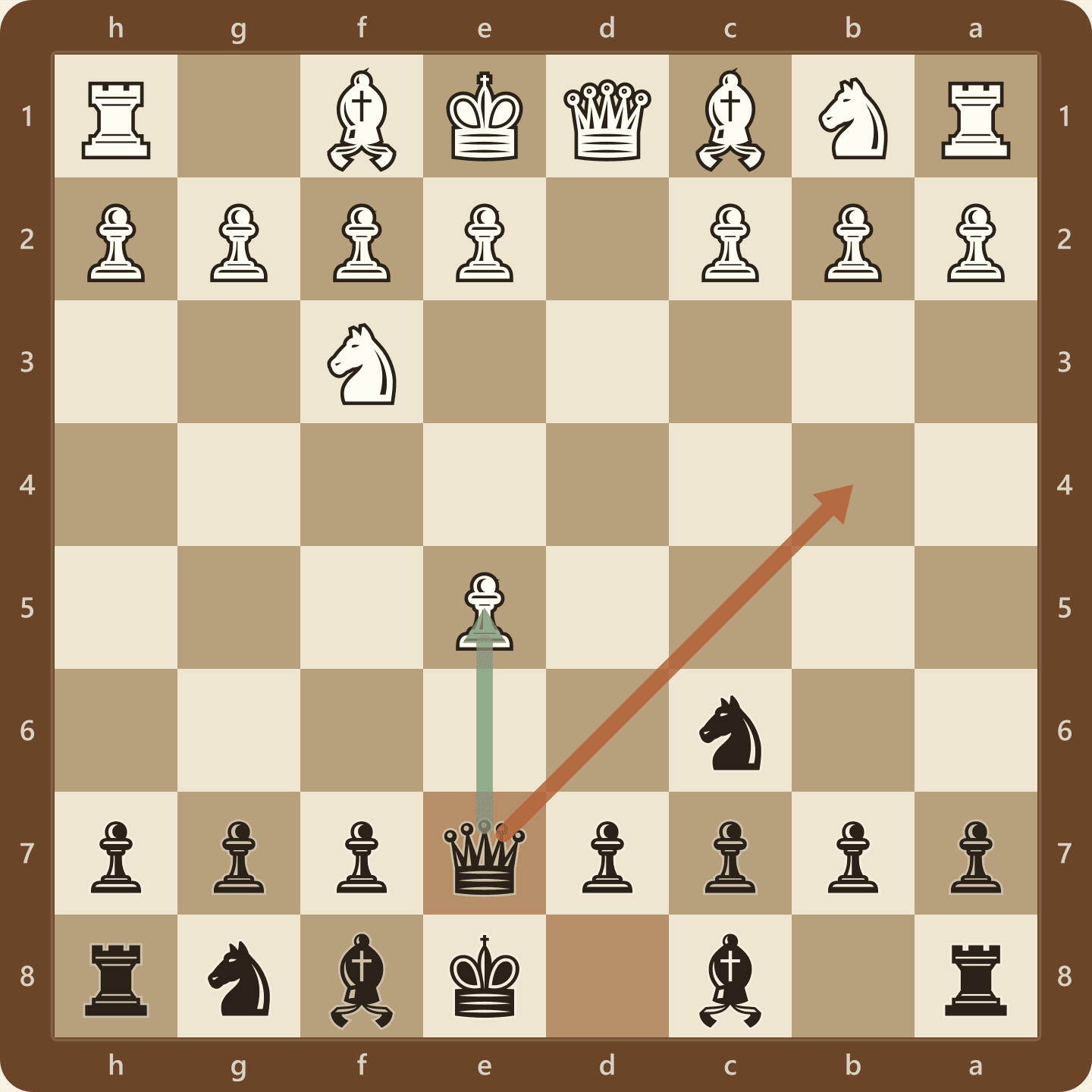
| 1.d4 e5 2.dxe5 Nc6 3.Nf3 Qe7 (Englund Gambit) | 1800 | 32.6% | 92 |
| 1.d4 d5 2.c4 dxc4 3.e3 (Queen's Gambit Accepted) | 1000 | 31.7% | 60 |
| 1.e4 e5 2.Nf3 Nc6 3.Bc4 Nd4 (Blackburne Shilling) | 1000 | 24.1% | 54 |
| 1.e4 e5 2.Nf3 f6 (Damiano Defense) | 1000 | 7.2% | 125 |
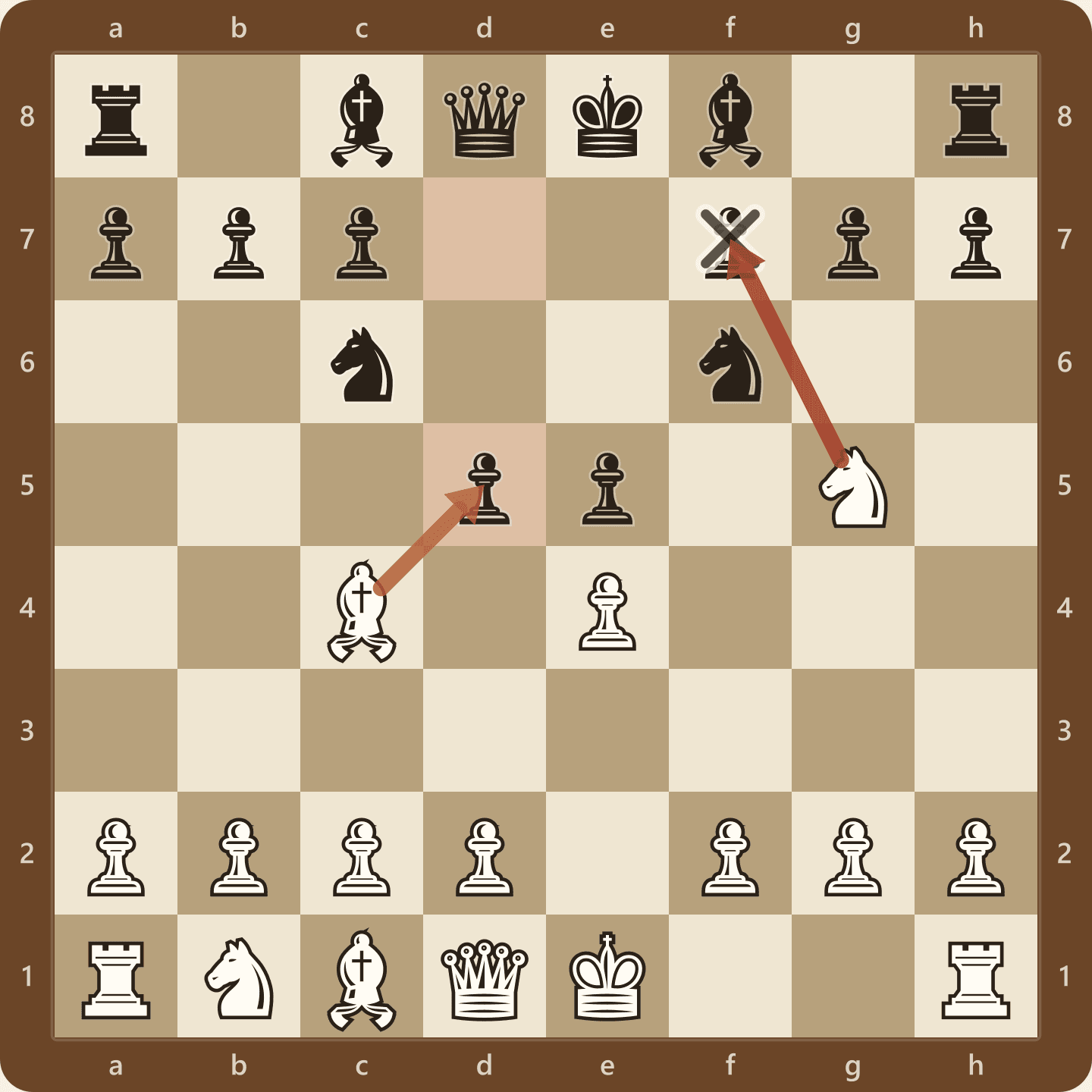
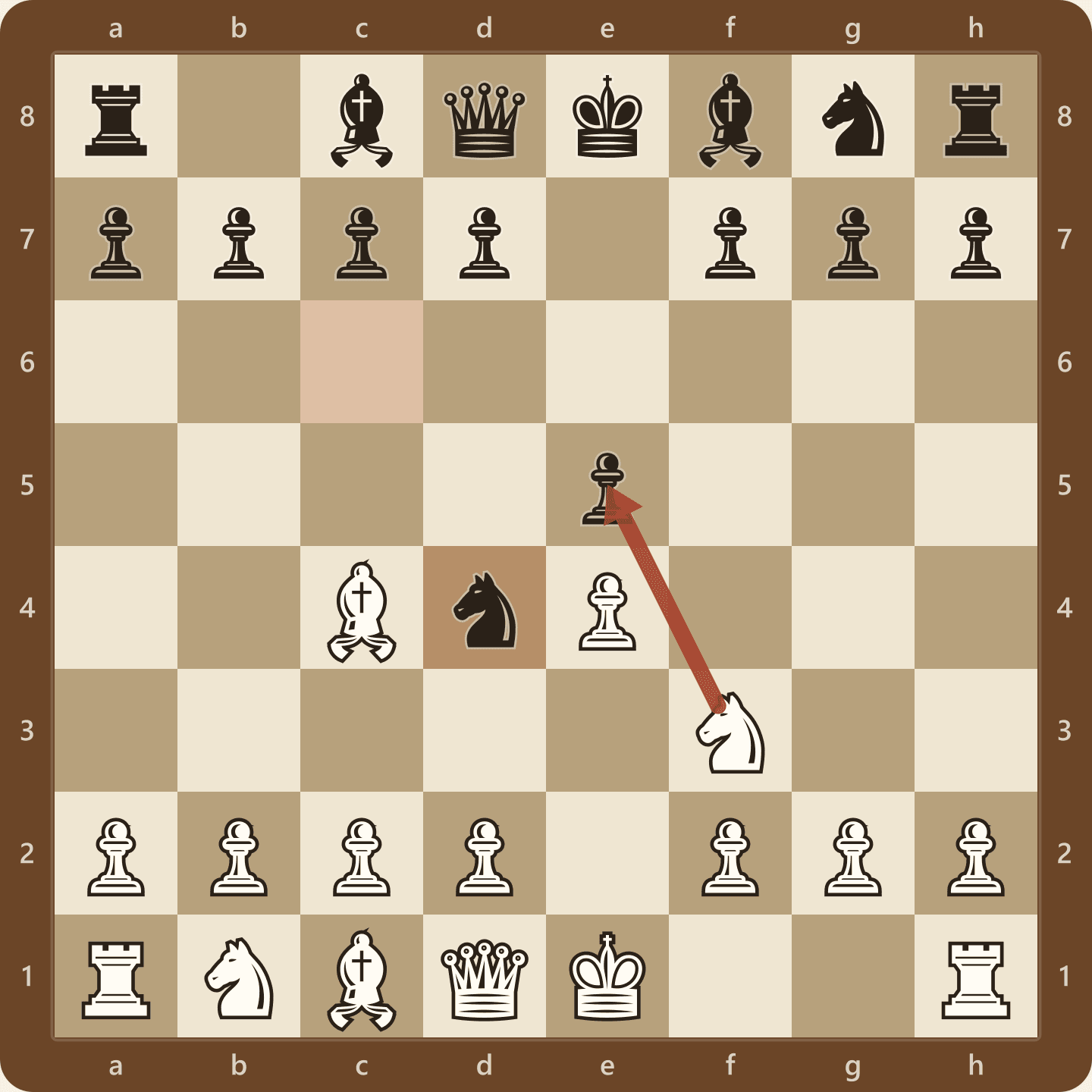
The Fried Liver row is the cleanest illustration. Black plays 4...d5 to hit the bishop, White answers 5.exd5, Black recaptures 5...Nxd5, and 6.Nxf7 drags the king out into the open. Nothing about the position is subtle. It simply requires Black to have reached it.
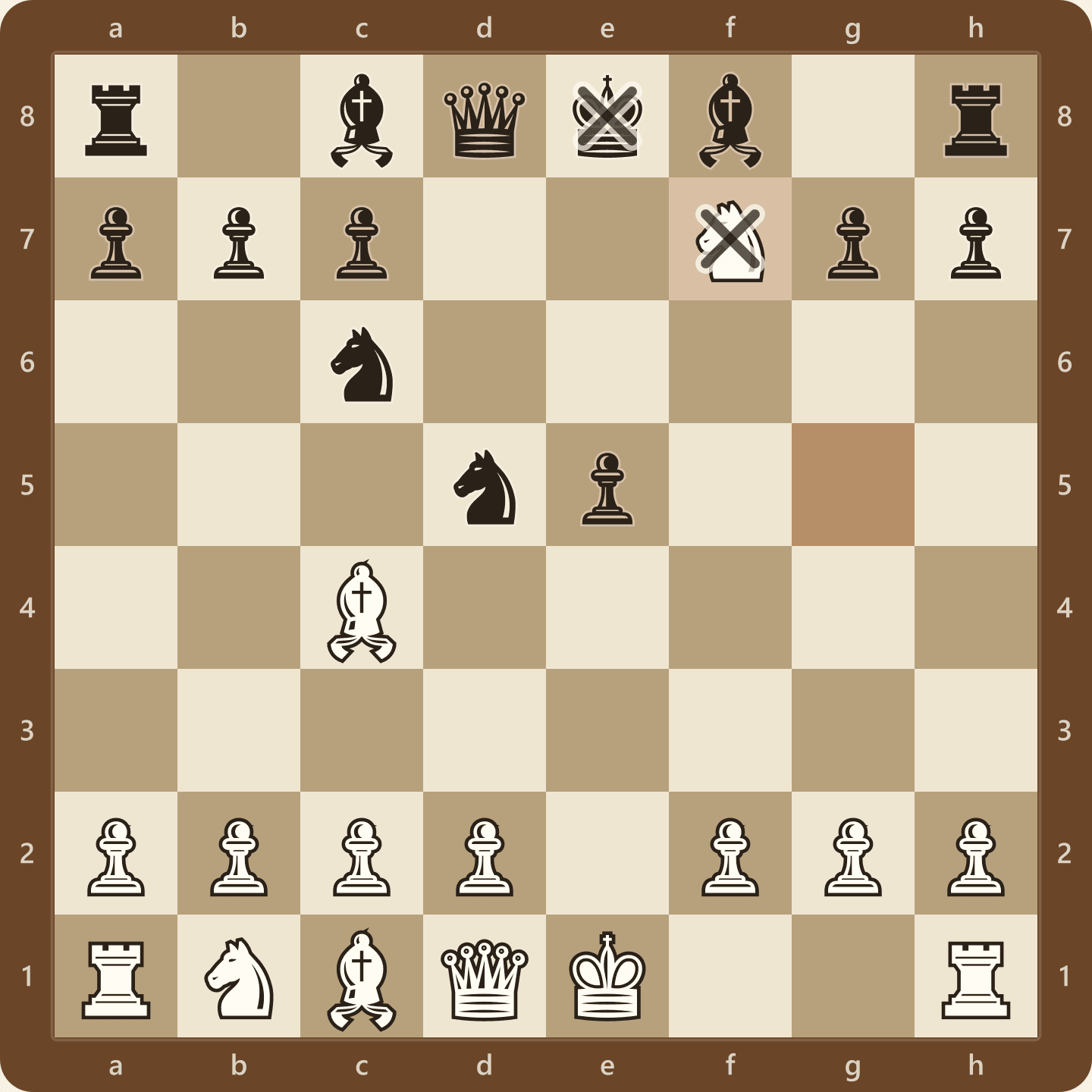
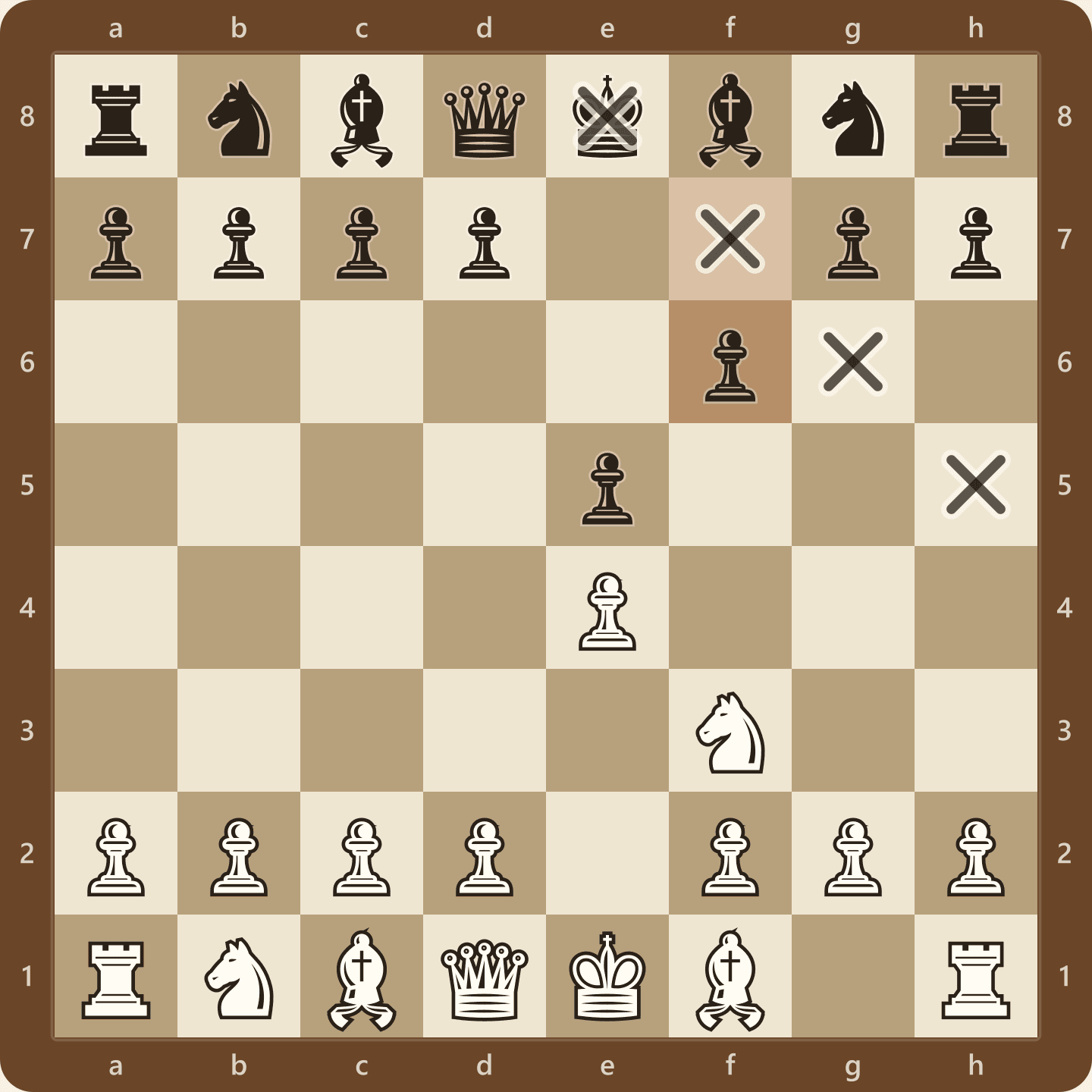
The other two well-sampled trap entries are cheaper still. The Blackburne Shilling Gambit invites White to grab the e5 pawn with a knight that is about to have a very bad day, and the Damiano Defense loses to a queen check almost immediately.
That gap is the whole psychology of opening traps. They feel dangerous because when they occur they are decisive, and they are statistically almost absent because you have to walk into a specific position first. The honest advice that falls out: do not study 25 traps, study the two or three whose entry positions you actually reach. The 15 traps every player should know and the Fried Liver Attack are the places to start.
Blunder, mistake, inaccuracy: the labels
There is no governing definition. Neither FIDE nor the USCF rules mention blunders, because it is an annotation convention rather than a rule. In chess notation the symbols are:
?!dubious move?mistake??blunder
Analysis engines on Lichess and Chess.com draw the lines by evaluation change rather than by feel, which is why the same move can be labelled differently on two sites. Roughly, an inaccuracy costs you a fraction of a pawn, a mistake costs about a pawn, and a blunder costs enough to change the result. What is a blunder in chess goes through the boundaries properly.
The rough taxonomy people use:
- Tactical blunders: hanging a piece, walking into a fork or a pin, missing a back-rank mate. These are what
mat-swing-v1catches. - Calculation errors: seeing the right idea and miscounting the sequence.
- Positional and strategic mistakes: a bad structural decision, a piece sent somewhere it will spend the game regretting. Invisible to a material check.
- Endgame technique failures: winning position, drawn result.
- Psychological blunders: time pressure, tilt after a bad result, moving fast because your opponent did.
Time pressure deserves its own note. This dataset is rapid and blitz, formats where the clock is a live participant in every move. That is one more reason the figures here should not be read as "how often do people blunder at chess" in general. They are how often people blunder online, fast, in the first few moves.
Grandmasters blunder too
The Wikipedia article on chess blunders is essentially a catalogue of the exception that proves the rule, and the names in it are the biggest in the game: Chigorin against Steinitz, Grünfeld against Alekhine, Petrosian against Bronstein, Najdorf against Fischer, Korchnoi against Karpov, Chandler against Polgar, and Carlsen on both sides of the ledger.
The most cited is Kramnik against Deep Fritz in 2006, where a world champion, with time on the clock and no obvious pressure, played into a mate in one. World Chess Championship matches and the Candidates Tournament reliably produce one of these per cycle, and Anand and Karjakin have both been on the receiving end.
For a statistical treatment at that level rather than an anecdotal one, ChessBase published an analysis of grandmaster blunders by Joe Doliner that takes the engine-evaluation route this page's method deliberately avoids. It is the right way to do it if you have the compute.
Has Magnus Carlsen ever blundered? Yes, in games that were broadcast live to hundreds of thousands of people. The relevant question for anyone reading this is not whether blunders stop, because they do not. It is how far they fall, and the answer in this sample is: about eight points across 1,200 rating points.
How to actually lower your blunder rate
The band data suggests the leverage is not where most improvers put it. Between 600 and 1000 the blunder rate does not move at all, which means whatever people do to gain those 400 points is not blunder reduction.
Four things that address the actual mechanism:
- Check every check, capture and threat your opponent has, before you move. Slow, boring, and the single highest-yield habit at these levels. Most tactical blunders are one-move oversights, not calculation failures.
- Play slower time controls while you build the habit. In blitz the checklist has nowhere to live.
- Learn the two or three trap entry positions you personally keep reaching. Not all 25. Look at your own games, find where you lose material before move ten, and learn that position specifically.
- Stop treating the opening as memorisation. The average game leaves book by ply 3.8. What you need is opening principles, not lines.
The other half of the picture is results rather than mistakes: which openings actually score, at your band, with the sample sizes attached. That is chess opening win rates, and the graded version is the chess opening tier list, which uses this blunder rate as one of its three inputs. If you want to look up any of these numbers yourself, how to use a chess opening explorer covers reading database statistics, and the full map of the subject is at chess openings.
Frequently asked questions
How common are blunders in chess?
In this sample of 97,740 Lichess rapid and blitz games from July 2026, an opening-phase material blunder shows up in 44.8% of games in the 600 rating band, 44.8% at 1000, 41.0% at 1400 and 36.9% at 1800. That is a per-game figure, so a game with several blunders counts once. It is measured by material swing rather than engine evaluation, which means positional blunders and missed mates are not included, so the true rate is higher than these numbers.
What is the difference between a chess blunder and a mistake?
It is a matter of degree, and there is no official definition from FIDE or the USCF. By convention, an inaccuracy (?!) costs a fraction of a pawn of evaluation, a mistake (?) costs roughly a pawn, and a blunder (??) costs enough to flip the likely result. Lichess and Chess.com each set their own engine thresholds, which is why the same move can be labelled differently on the two sites.
At what rating do people stop blundering?
They do not. On this data the blunder rate is essentially identical at the 600 and 1000 bands (44.8% both), drops to 41.0% at 1400 and 36.9% at 1800. Extrapolating that slope, blunders would still appear in a large share of games well above 2000. Grandmasters blunder in broadcast games; the difference is frequency and severity, not absence.
How do I avoid blunders in chess?
Run a fixed check before every move: what checks, captures and threats does my opponent now have? Most blunders at these levels are one-move oversights, not deep calculation failures. Play a slower time control while the habit forms, since blitz gives the checklist nowhere to live, and review your own losses for the specific positions where you keep shedding material before move ten.
Has Magnus Carlsen ever blundered?
Yes, including in games broadcast live. Wikipedia's catalogue of notable blunders lists him on both sides, and the most famous engine-era example is Vladimir Kramnik playing into a mate in one against Deep Fritz in 2006. Blunders at the top are rare enough to be newsworthy, which is exactly why they get catalogued and amateur ones do not.
How often do chess traps actually work?
Almost never, and then constantly. Across the whole 97,740-game sample, about 320 games (0.33%) reached any of 25 catalogued trap positions. But conditional on reaching the position a trap lives in, the trap fires often: 63.0% of games that reached 1.e4 e5 2.Nf3 Nc6 3.Bc4 Nf6 4.Ng5 d5 in the 1000 band went down the Fried Liver line, from a sample of 92 games.