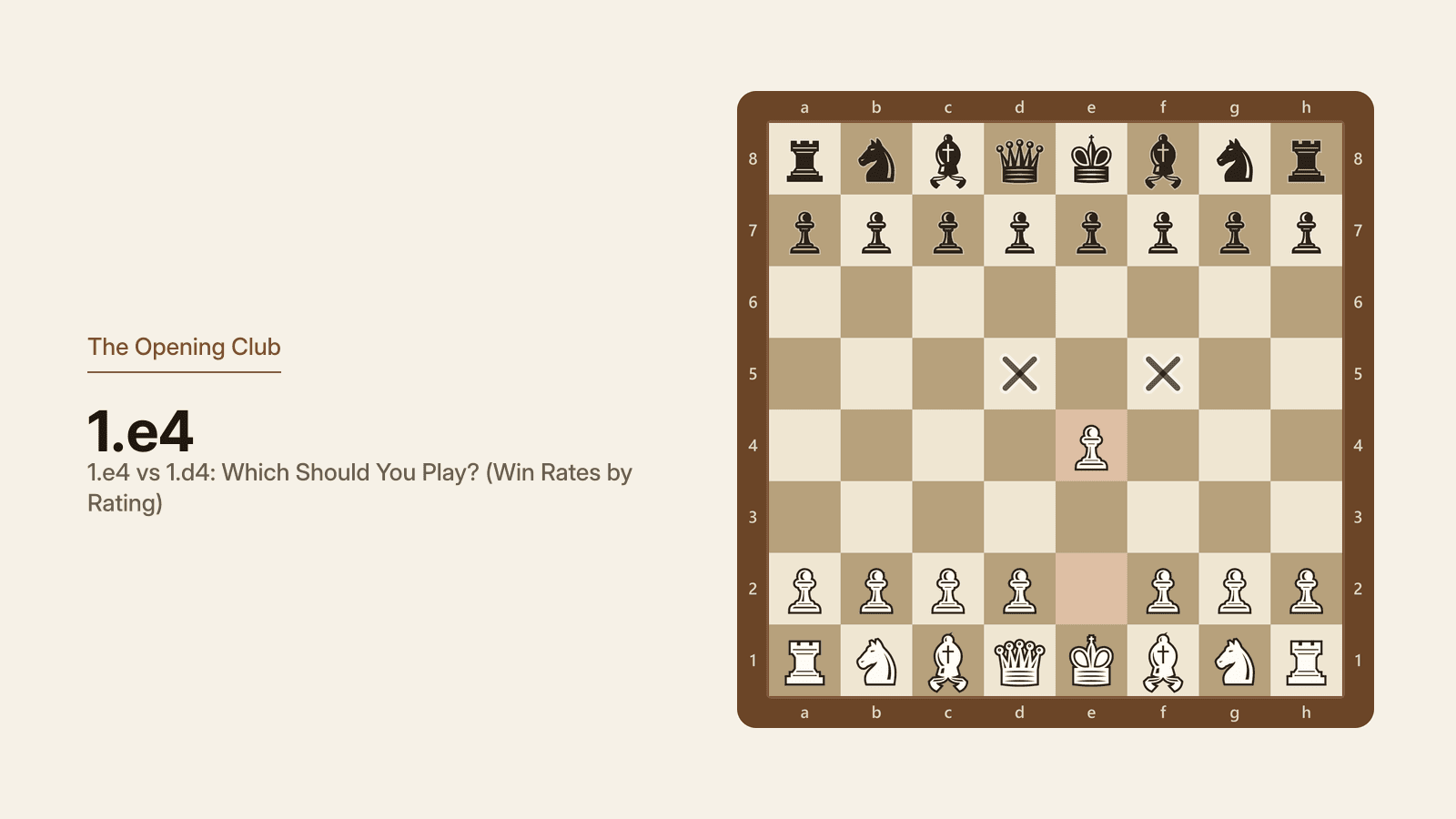
Every chess club has this argument, and almost nobody brings numbers to it. So here is the e4 vs d4 question settled the boring way: with 49.8 million games from the Lichess open database, split by rating band, with the sample size printed next to every figure.
The headline is that 1. d4 scores higher than 1. e4 at three of the four rating bands we track, and the gap grows as players get stronger. The headline is also that the gap is under one and a quarter percentage points, which is smaller than almost anything else you could work on. Both things are true, and the second one matters more than the first.
The scores, band by band
A quick note on how we count. A "score" here is wins plus half of draws, from White's side, which is the standard way to compress a win/draw/loss record into one number. Rating bands are Lichess bucket lower bounds, so the 1000 band means players rated 1000 and up to the next bucket, not "around 1000". There is no 800 or 1200 band. All figures below are rapid and blitz games from the Lichess open database for 2026-05, the same publicly downloadable game dump that powers the Lichess opening explorer.
| Rating band | 1.e4 score (White) | 1.e4 games | 1.d4 score (White) | 1.d4 games | Edge |
|---|---|---|---|---|---|
| 600 | 52.4% | 2,849,881 | 52.3% | 836,518 | 1.e4 by 0.2 pts |
| 1000 | 51.9% | 9,343,706 | 52.8% | 3,174,376 | 1.d4 by 0.9 pts |
| 1400 | 51.3% | 6,813,943 | 52.4% | 2,614,908 | 1.d4 by 1.1 pts |
| 1800 | 51.3% | 12,493,284 | 52.4% | 5,546,280 | 1.d4 by 1.2 pts |
Read that column of sample sizes before you read anything else. These are not 400-game curiosities. The smallest cell in the table is 836,518 games. When we rank openings we use a Wilson lower bound rather than the raw percentage, because that is what stops a 200-game line from outranking a two-million-game one, and at these volumes the lower bound sits within a tenth of a point of the raw score. Nothing here is noise.
Two patterns fall out.
First, 1. e4 only wins the head-to-head in the lowest band, and it wins it by 0.2 points, which on 2.8 million games is real but tiny. From the 1000 band upward, 1. d4 is ahead every time.
Second, 1. e4 gets steadily worse as the rating goes up (52.4, 51.9, 51.3, 51.3) while 1. d4 dips once and then holds flat (52.3, 52.8, 52.4, 52.4). Whatever advantage 1. e4 has is an advantage against weak opposition specifically.
What 1.e4 buys you, in one move
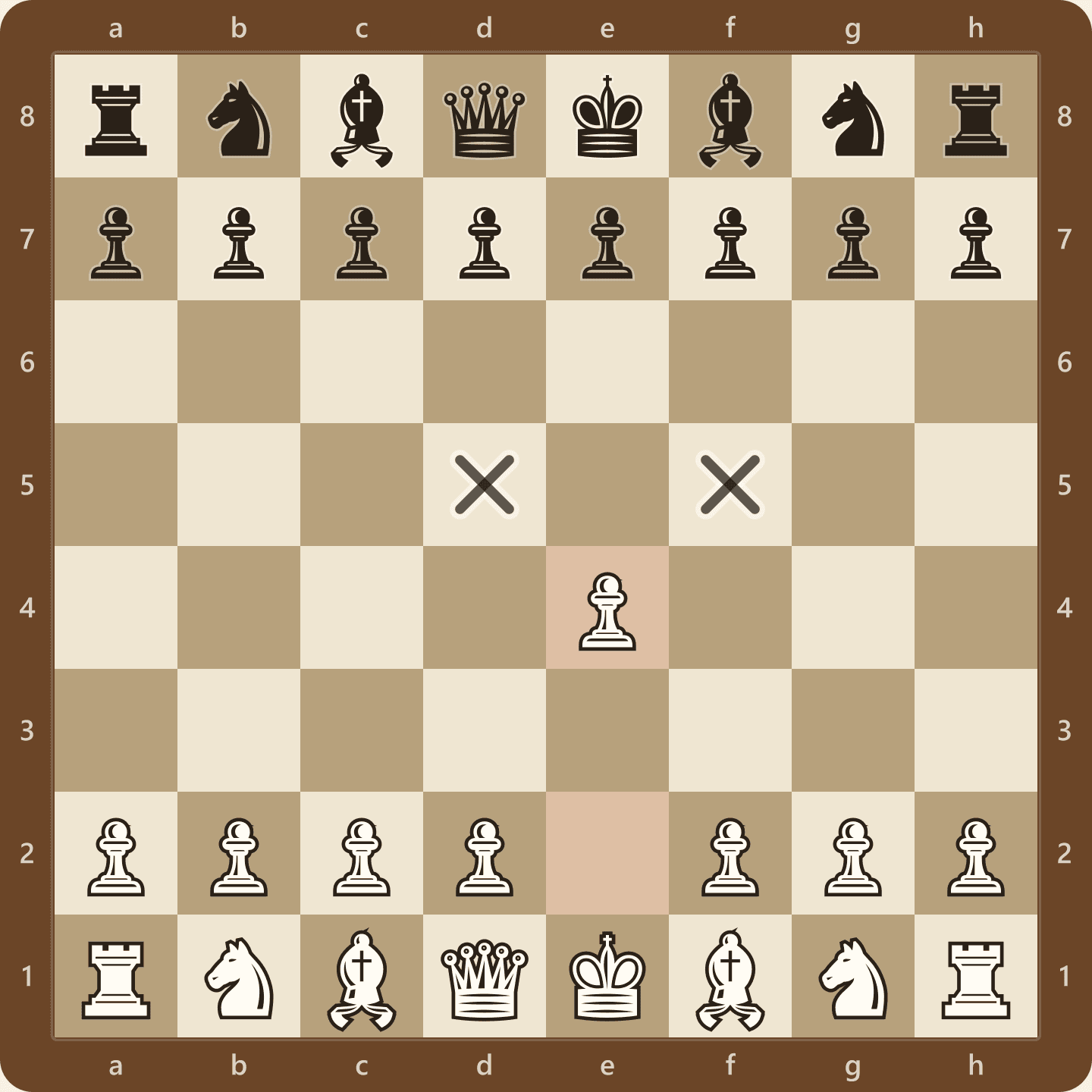
1. e4 opens lines for the queen and the light-squared bishop in a single move. That is the whole case for it, and it is a good case. It is also why it dominates the popularity table: 66.8% of all games in the 600 band start 1. e4, against 19.6% for 1. d4.
But notice what happens to those shares as players improve. At the 1800 band, 1. e4 is down to 59.7% and 1. d4 is up to 26.5%. Stronger players are quietly drifting toward the queen's pawn, and the score table says they have a reason.
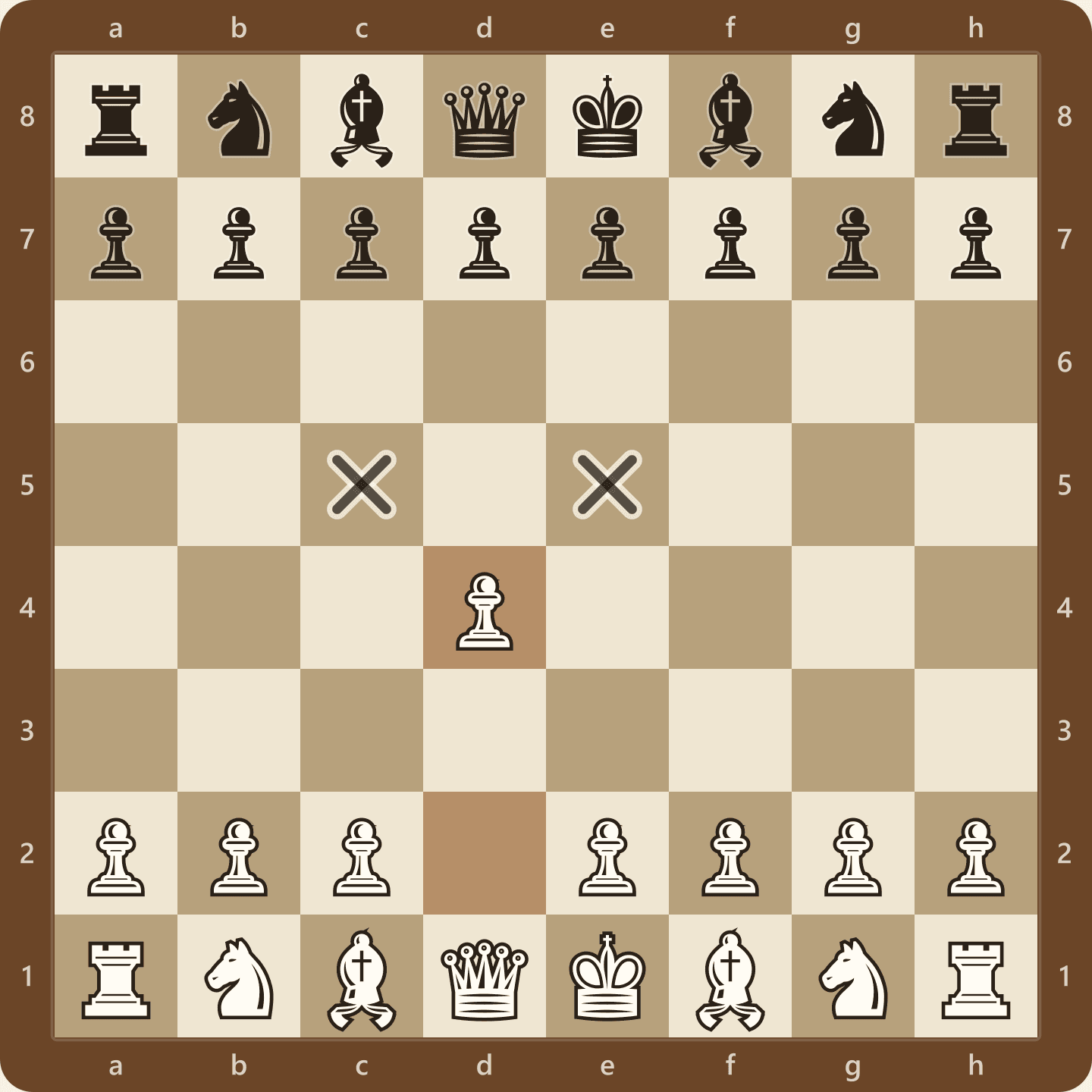
The difference between the two moves that actually shows up in the results is not "open versus closed". It is that the d4 pawn is defended by the queen the moment it lands, and the e4 pawn is not. Black can hit e4 immediately with 1...d5, 1...Nf6 or 1...c5 and force White to make a decision on move two. Nobody wins a game off that on its own, but it is the structural reason the queen's pawn positions are calmer, and calmer positions are where the extra half-point lives.
Why 1.d4 outscores 1.e4
This is the part the forum threads never get to, because it needs the data split one level deeper. Here is White's score against each of the common replies at the 1000 band.
| Black's reply | White's score | Games (1000 band) |
|---|---|---|
| 1.e4 e5 | 52.9% | 5,115,257 |
| 1.e4 d5 (Scandinavian) | 51.8% | 947,614 |
| 1.e4 e6 (French) | 50.0% | 724,903 |
| 1.e4 c6 (Caro-Kann) | 49.5% | 658,827 |
| 1.e4 c5 (Sicilian) | 49.2% | 850,797 |
| 1.d4 d5 | 53.6% | 1,684,690 |
| 1.d4 e6 | 52.9% | 289,062 |
| 1.d4 Nf6 (Indian) | 51.0% | 338,880 |
| 1.d4 e5 (Englund Gambit) | 51.0% | 268,668 |
Two things explain the whole gap.
White's best day is better after 1.d4. The main line of each opening is the one you will face more than half the time, and White scores 53.6% in the 1. d4 d5 main line against 52.9% in the 1. e4 e5 main line. That is most of the difference right there.
White's worst day is worse after 1.e4. The three replies that genuinely hurt White are the Sicilian, the Caro-Kann and the French, and all three answer 1. e4. The queen's pawn has no equivalent. Its most annoying reply, the Indian move order with 1...Nf6, still leaves White scoring 51.0%.
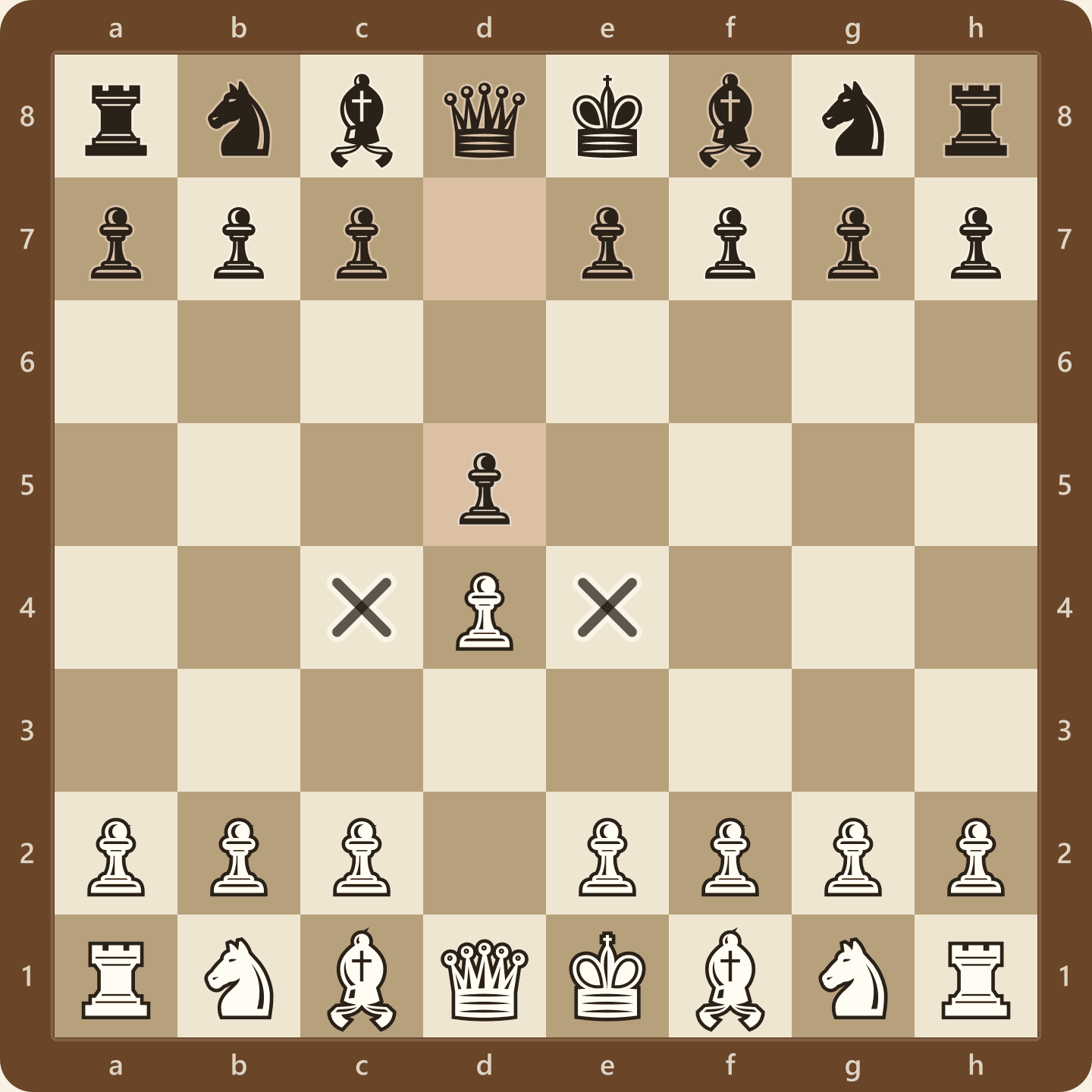
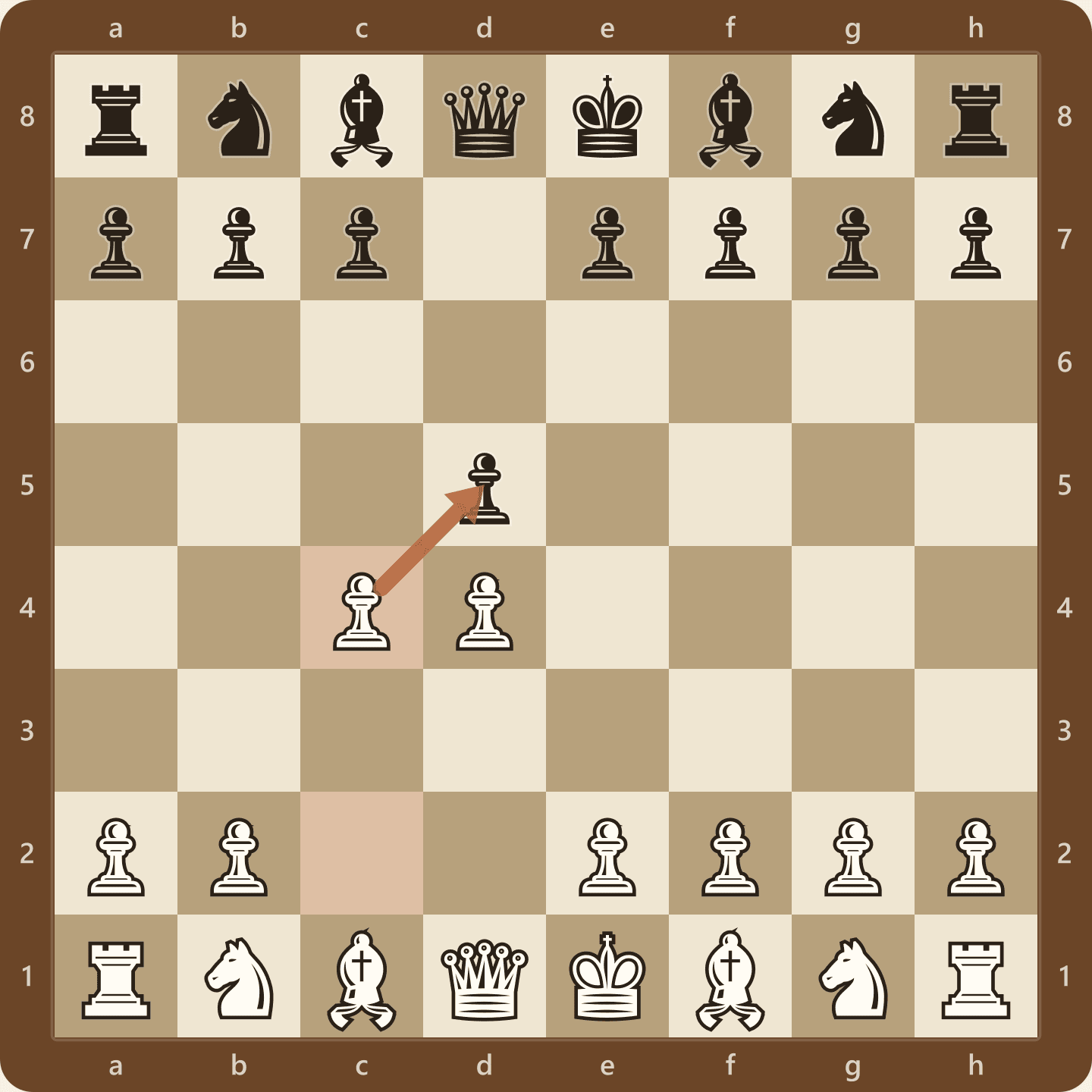
Go one move deeper and the pattern holds. At the 1000 band the Queen's Gambit (1. d4 d5 2. c4) scores 55.1% for White across 455,625 games, and the London System (2. Bf4) scores 54.3% across 438,927. On the king's pawn side, the Ruy Lopez manages 53.6% on 369,070 games and the Italian Game 52.7% on 965,410. Both 1. d4 second moves beat both 1. e4 third moves.
The theory burden is a myth, and the data says so
The standard advice is that 1. e4 forces you to learn five separate defenses while 1. d4 lets you play one setup against everything. Every version of this argument you will read online assumes it rather than checking it. We checked it.
At the 1000 band, here is how concentrated each first move's replies actually are, as a share of that move's own games:
- After
1. e4:1...e5is 54.7%, then1...d510.1%,1...c59.1%,1...e67.8%,1...c67.1%. Top five: 88.8%. - After
1. d4:1...d5is 53.1%, then1...Nf610.7%,1...e69.1%,1...e58.5%,1...g63.6%. Top five: 85.0%.
They are the same shape. Both first moves funnel into one dominant reply just over half the time, and both have their top five covering roughly six games in seven. If anything, 1. e4 is the more concentrated of the two at this level.
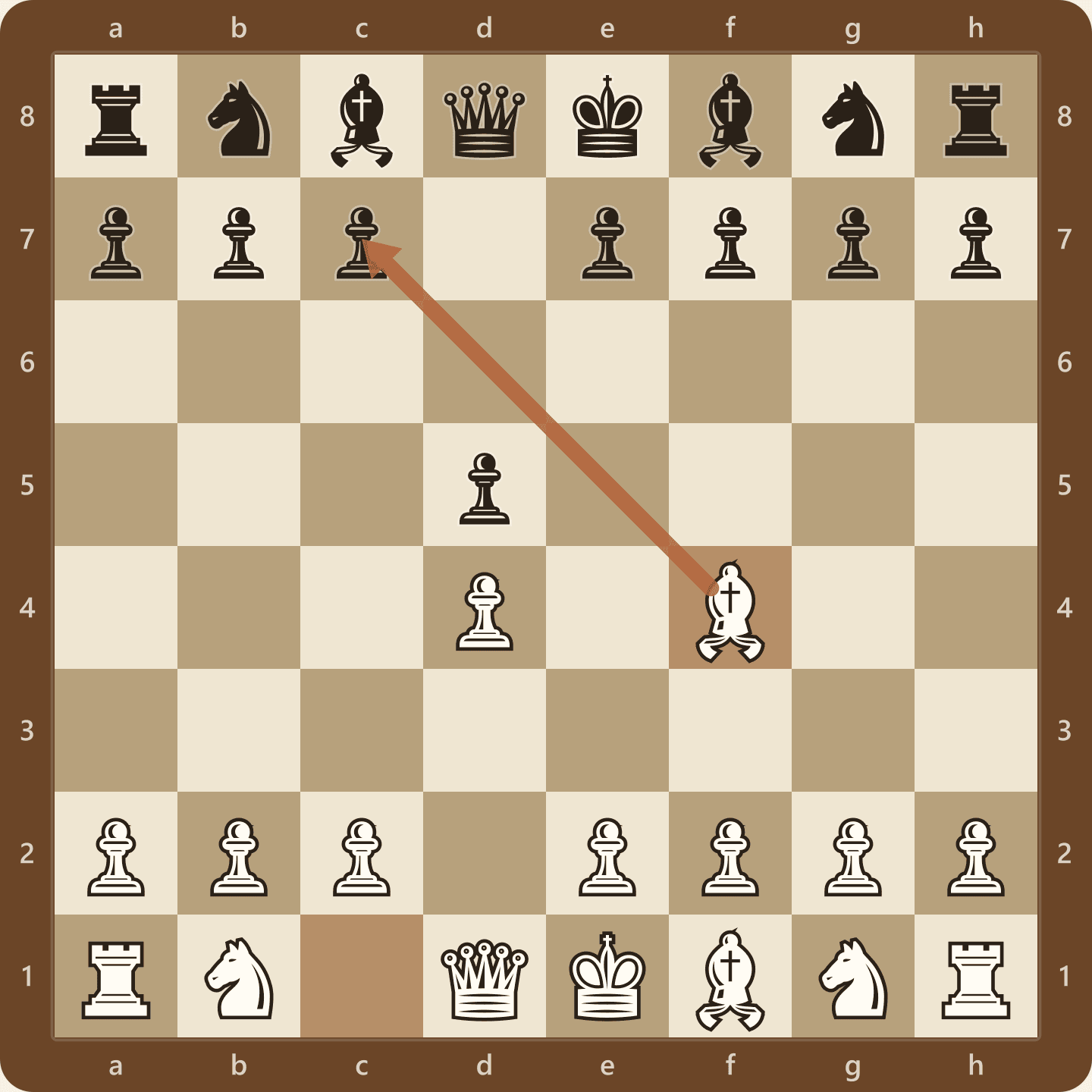
What is true is that the 1. e4 replies lead to more different-feeling positions. A Sicilian and a French do not resemble each other. A Slav and a Queen's Gambit Declined mostly do. So the preparation requirement is not "more lines" so much as "more distinct plans", and that is a real cost, just a smaller one than the folklore claims. If you want the low-theory route, both first moves have one: the London System after 1. d4, and the Italian Game after 1. e4.
The Sicilian problem is real, and it is smaller than you think
The Sicilian Defense is the single reason most people give for abandoning 1. e4. The numbers half-support them. At the 1000 band White scores 49.2% against 1...c5 across 850,797 games, which is the worst result any common first-move reply produces. It recovers only slightly higher up: at the 1800 band White scores 50.2% against the Sicilian across 2,610,015 games, still the weakest of White's common outcomes.
But look at the exposure. The Sicilian is 9.1% of your games as a 1. e4 player at the 1000 band. Losing 2.7 points of score on 9% of your games costs you about a quarter of a point overall. The Sicilian is not what makes 1. e4 score lower. The 1. e4 e5 main line being slightly less profitable than the 1. d4 d5 main line is what makes 1. e4 score lower, and that shows up in more than half your games.
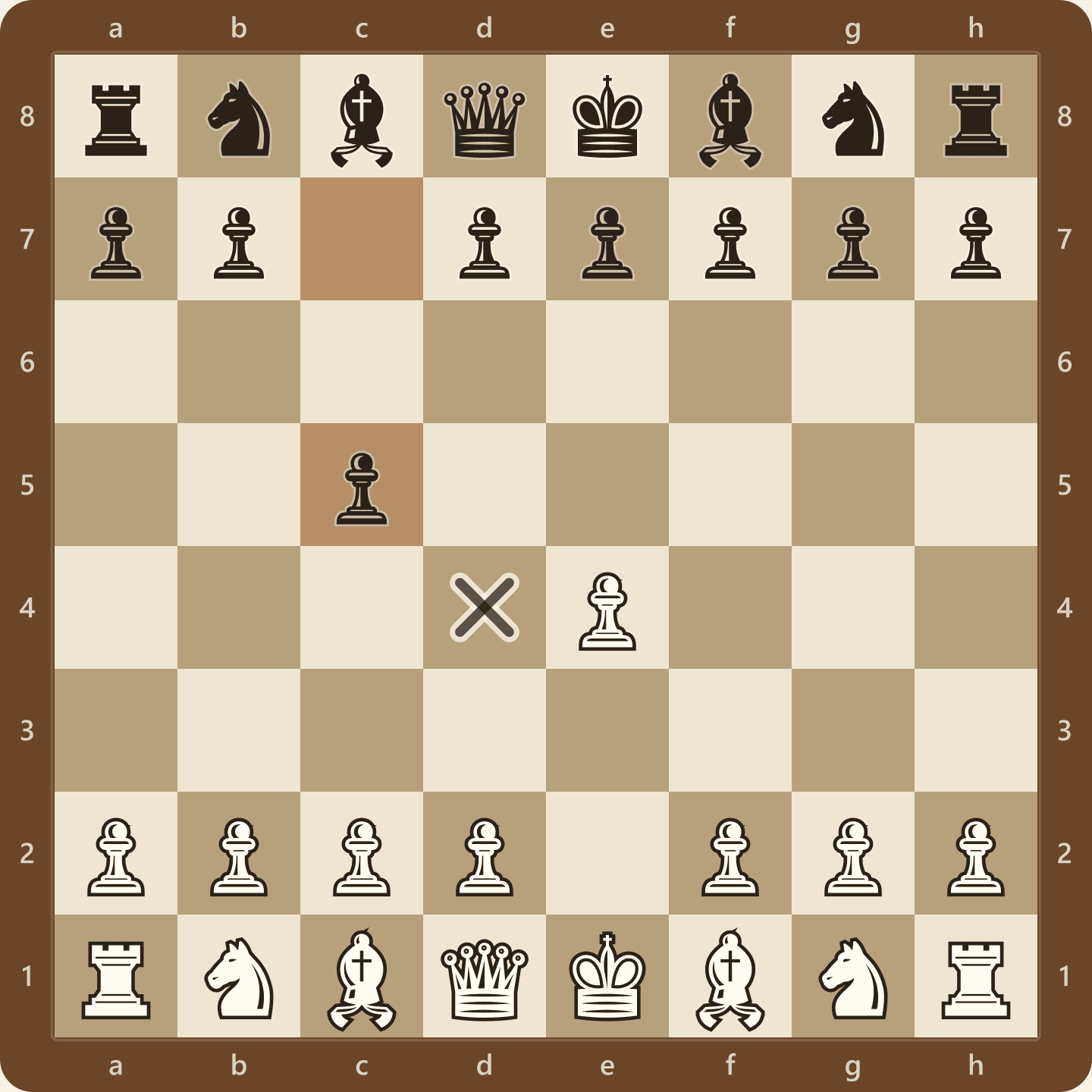
If you play 1. e4 and the Sicilian genuinely bothers you, the fix is a system answer such as the Alapin (2. c3), not a change of first move. We cover that in how to beat the Sicilian.
Open versus closed, tactical versus positional
This is the framing everyone uses, so it is worth saying plainly what it does and does not mean.
1. e4 tends toward open positions: pawns get traded early, files open, pieces meet, and games are decided by tactics. 1. d4 tends toward closed and semi-closed positions: the pawn chains lock, both sides manoeuvre behind them, and games are decided by which plan was better. That is a genuine difference in the texture of the game, and it is the honest reason to pick one over the other.
What it does not mean is that one is harder. The draw rates are almost identical (3.7% versus 3.8% at the 1000 band), so 1. d4 is not producing safe, sleepy games at amateur level. Both first moves produce a decisive result about 96 times in 100.
It also does not mean 1. d4 is a "positional player's move" in any way that should influence a 1000-rated player's choice. At that level games are decided by hanging pieces, not by strategic understanding, and the King's Gambit sits inside the 1. e4 world while the Trompowsky Attack (1. d4 Nf6 2. Bg5) sits inside the 1. d4 world. Both first moves contain plenty of chaos if you go looking.
What the strongest players do
Bobby Fischer was the great 1. e4 believer and played it almost to the exclusion of everything else. Garry Kasparov built his career largely on 1. d4 and the closely related 1. Nf3 and 1. c4 move orders, while still producing some of the most famous 1. e4 games ever played. Magnus Carlsen plays all of them and has been happy to open with the English Opening or the Reti in world championship play.
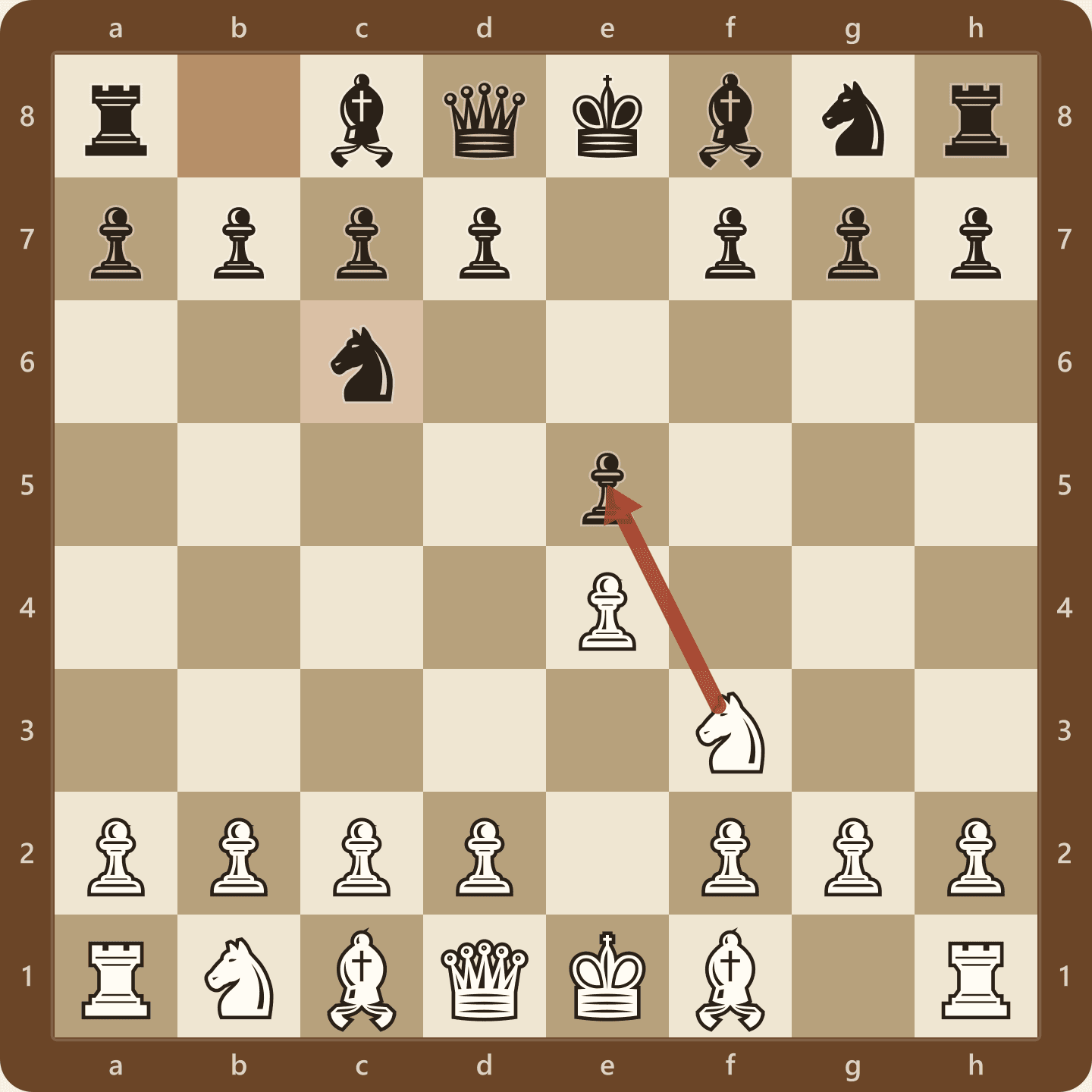
The pattern at the top is not a preference for one pawn. It is a preference for whichever move takes the opponent out of preparation, which is a problem you do not have. At elite level 1. e4 also runs into the Berlin Defense (1. e4 e5 2. Nf3 Nc6 3. Bb5 Nf6), an endgame-flavoured line that has drawn hundreds of top games and has essentially no relevance below 2200. Databases such as ChessBase's, which are built from master play, therefore tell you something genuinely different from what the Lichess amateur pool tells you. Ours is the amateur pool, on purpose.
Transpositions blur the line anyway
You do not fully choose your opening with move one. 1. Nf3 and 1. c4 both frequently transpose into 1. d4 structures, and 1. e4 e6 2. d4 d5 is a French that reaches a queen's pawn centre. A London player who meets 1...Nf6 with 2. Bf4 is playing the same bishop-outside setup whether Black chose 1...d5 or not.
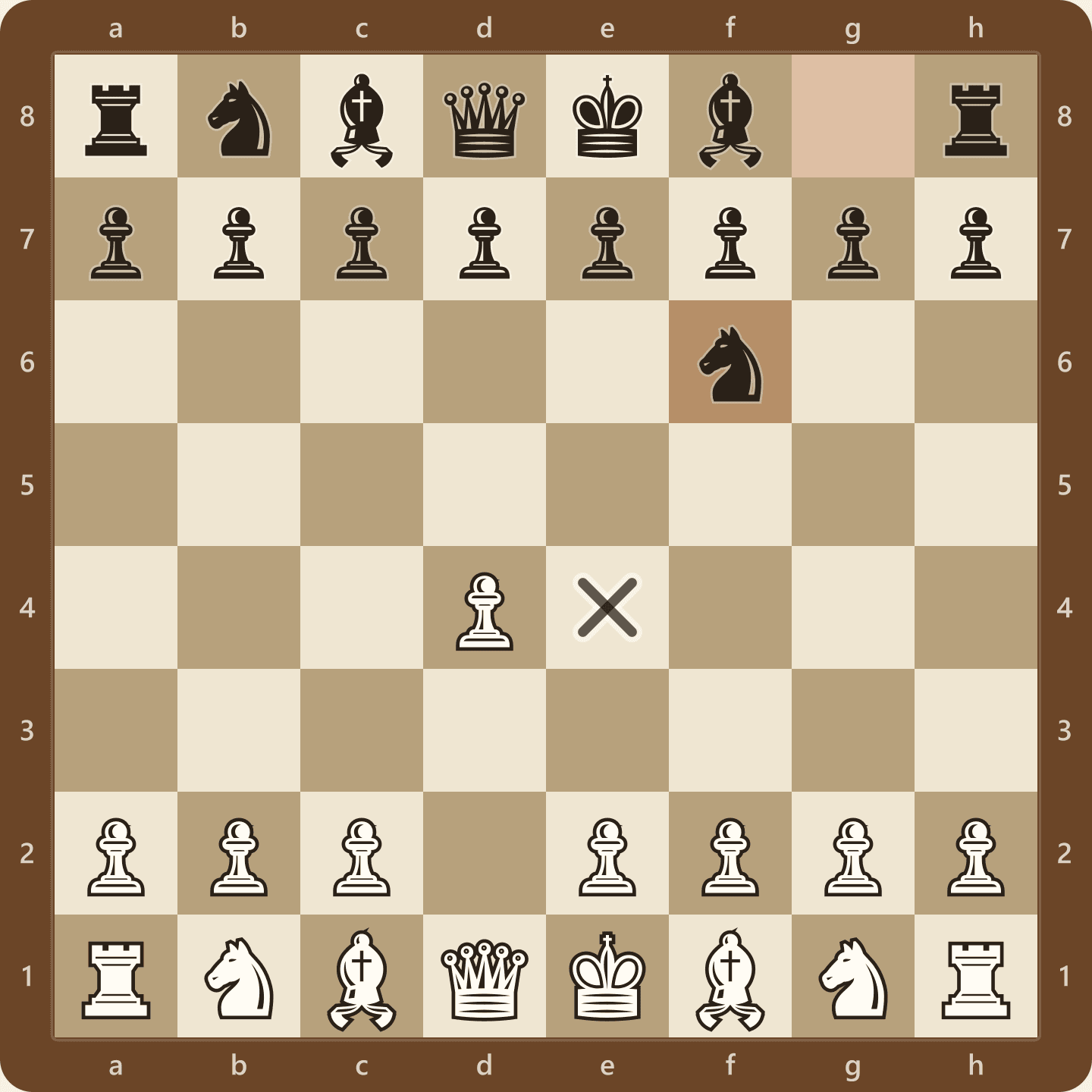
The practical consequence is that switching later is cheaper than it sounds. Most of what you learn about pawn structures, piece placement and plans travels with you. What does not travel is your first fifteen moves of memorised lines, and at amateur level you have fewer of those than you think.
So which one should you play?
Frequently asked questions
Frequently asked questions
What is the difference between e4 and d4?
1. e4 pushes the king's pawn two squares, opening lines for the queen and the light-squared bishop but arriving on a square nothing defends. 1. d4 pushes the queen's pawn, opening a line for the dark-squared bishop only, but arriving defended by the queen. In practice 1. e4 leads to open, tactical positions more often and 1. d4 to closed, plan-driven ones.
Is e4 or d4 better for beginners?
1. e4, narrowly. It is the only rating band in our data where the king's pawn actually outscores the queen's pawn (52.4% against 52.3% at the 600 band, across 2,849,881 and 836,518 games). It also produces open positions where tactics decide games, and tactics are the skill that improves a beginner's results fastest.
Is d4 better than e4?
On raw score, yes, from the 1000 band upward. 1. d4 scores 52.8%, 52.4% and 52.4% at the 1000, 1400 and 1800 bands against 51.9%, 51.3% and 51.3% for 1. e4, in the Lichess open database for 2026-05 across rapid and blitz. The gap is roughly one percentage point, so it is real but small enough that your choice should turn on which positions you enjoy.
Why is e4 more aggressive than d4?
Because it opens two lines instead of one and lands on an undefended square, which invites an immediate confrontation. Black usually challenges the centre at once, pawns come off earlier, and files open sooner. The result is a game decided by tactics rather than by manoeuvring. Draw rates say this is not about safety though: both first moves produce a decisive result about 96% of the time at amateur level.
What is the most popular defense to e4?
1...e5, by a distance. It accounts for 54.7% of all 1. e4 games at the 1000 band, or 5,115,257 games in the 2026-05 Lichess data. The Scandinavian (1...d5) is next at 10.1%, then the Sicilian (1...c5) at 9.1%, the French (1...e6) at 7.8% and the Caro-Kann (1...c6) at 7.1%.
Does the first move choice matter as much as people say?
No. The measured gap between the two is about 1.2 percentage points of score at the 1800 band. For comparison, the gap between the best and worst defenses Black can pick against 1. e4 is more than twice that at the same band. First-move choice is one of the smaller levers available to an improving player.
A note on what we did not publish
We track a blunder-rate figure alongside the win rates, and it is the reason 1. d4 grades slightly lower than 1. e4 at the 1800 band despite scoring higher. We have deliberately not quoted that number here. The blunder dataset is a material-swing proxy rather than engine evaluation, and its per-opening samples run to a few hundred games where the win-rate samples run to millions. A win rate without its rating band and sample size is worse than no number at all, and that applies to our own figures first.
If you want the fuller picture, the opening win rates page carries the whole table, the tier list grades every line per band and per colour, and blunder rate by rating explains the proxy properly.
Where to go next
- Ranking every first move, not just these two: the best first move in chess
- Playing the other side: best openings for Black against 1.e4 and against 1.d4
- Sharper options for either move: the best chess gambits, ranked
- Picking a full repertoire: best chess openings and what chess opening should I play