To learn chess openings without memorizing endless lines, pick one opening for White and one answer each to 1.e4 and 1.d4 as Black. Learn the first six moves of each as a plan rather than a list, then use your own games to find the exact move where you stopped knowing what to do.
Fix that move. Repeat weekly. That is the whole method, and the rest of this page is what each part looks like in practice.
Why memorizing lines stops working around move six
Opening theory (published analysis of the first moves of a game) is written by strong players for strong players. It assumes your opponent knows the same book you do. Below roughly 1800 rapid, they usually do not, and they leave the book long before the interesting part.
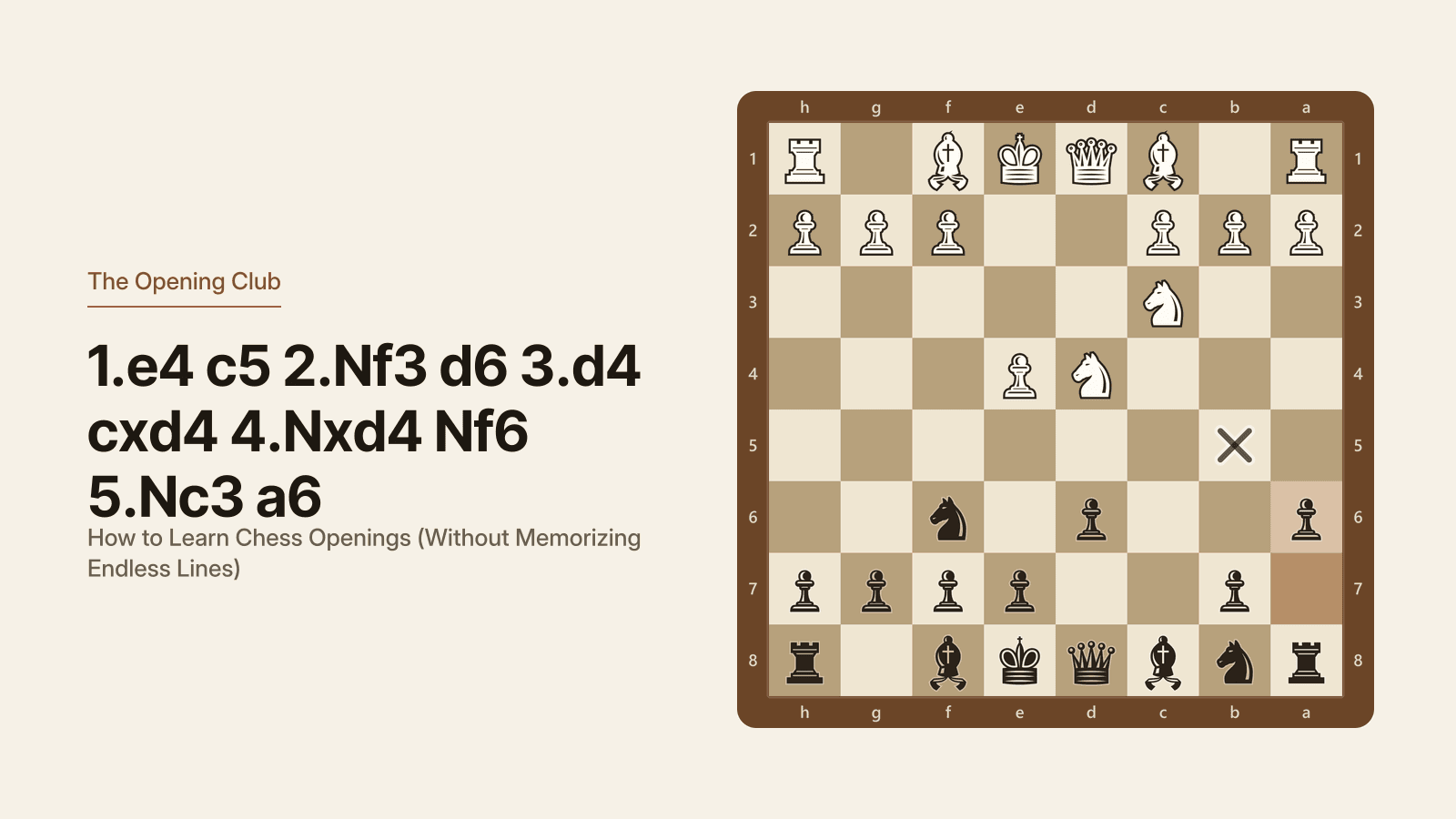
Here is what the deep end looks like. This is the Sicilian Najdorf after 1.e4 c5 2.Nf3 d6 3.d4 cxd4 4.Nxd4 Nf6 5.Nc3 a6, one of the most analysed positions in chess.
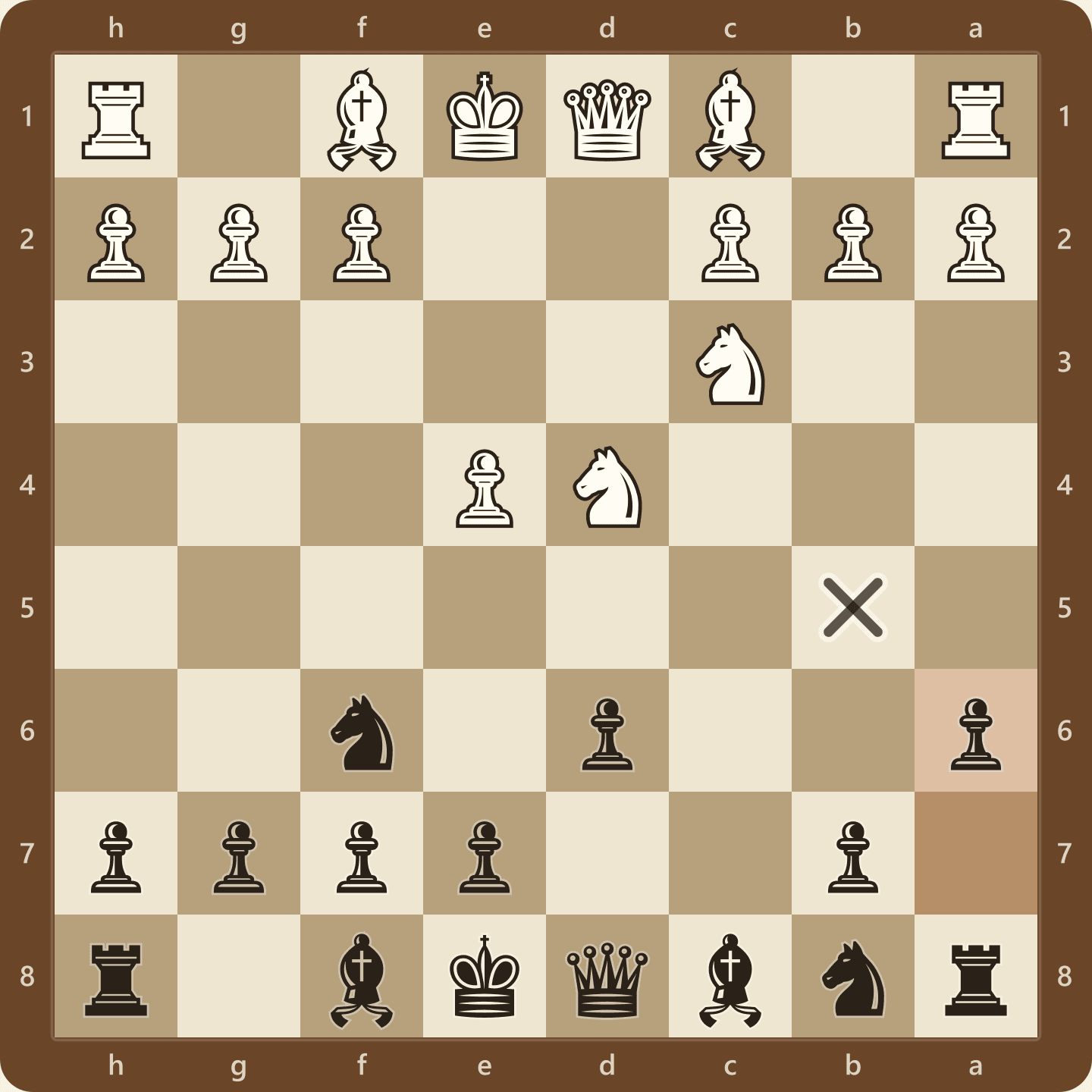
Your opponent plays 2.Bc4 or 3.Bb5 instead and the book closes on move two. A memorized fifteen-move line is a set of answers to questions nobody at your level is asking, and when the memory runs out you are improvising in a position you never looked at, which is where you were before you studied.
We are not going to attach a percentage to that. A claim like "most games leave theory by move six" needs a rating band and a sample size before it means anything, and our dataset is still being built. When it is ready the numbers will live on chess opening win rates and blunder rate by rating, with the band and the game count printed beside every figure.
What survives contact with a 1000-rated opponent is the set of opening principles: develop toward the center, castle early, do not move the same piece twice for no reason, do not chase material with your queen on move four. They are not a consolation prize for people too lazy to study. They are what the theory is built out of.
The method, in five steps
Step 1
Pick three openings and stop shopping
One first move as White, one reply to 1.e4 as Black, one reply to 1.d4 as Black. Three total. The biggest time sink for improving players is not choosing badly, it is choosing again every three weeks. If you cannot decide, run the opening picker and take what it gives you.
Step 2
Learn five or six moves as a plan, not a list
For each opening, write one sentence answering three questions: where do my pieces want to go, what is my pawn structure trying to do, and what is my opponent's most annoying idea. If you cannot write those sentences, you have not learned the opening yet no matter how many moves you can recite.
Step 3
Play them in rapid, not blitz
10+0 or 15+10 on Lichess or Chess.com. Blitz teaches your hands the moves and teaches your head nothing, because you never have time to notice you are confused. Aim for five or six rapid games in a sitting so you meet several different replies.
Step 4
Find your departure point in every game you lost
Step forward from move one and mark the first move where you were guessing. Not the blunder, the guess. That is usually four to eight moves before the position fell apart. The Lichess opening explorer and Chess.com's Game Review both show where you left known territory. Full walkthrough in how to use a chess opening explorer.
Step 5
Turn each departure point into one card, and review twice a week
Position on the front, the move plus one sentence of why on the back. Ten minutes, twice a week, is enough. A spaced repetition tool schedules the reviews so you see a card just before you would have forgotten it. This is the only part of opening study that should feel like study, and it should be short.
The loop runs weekly. Play, mark departure points, add two or three cards, review. If your study session takes an hour, something in it is entertainment rather than work.
Step 1 in practice: openings you will actually keep
You want openings that reward understanding rather than recall. For White, the Italian Game, the London System, the Scotch Game, the Vienna Game and the Queen's Gambit all qualify. The Ruy Lopez is excellent chess and a heavier reading list, so it makes a better second repertoire than a first.
For Black against 1.e4, the Caro-Kann Defense, the French Defense and the Scandinavian Defense each give you one structure you learn once and reuse. The Scandinavian is the extreme case: Black trades the center off immediately with 1.e4 d5 2.exd5 Qxd5, and the whole opening hangs on where that queen goes.
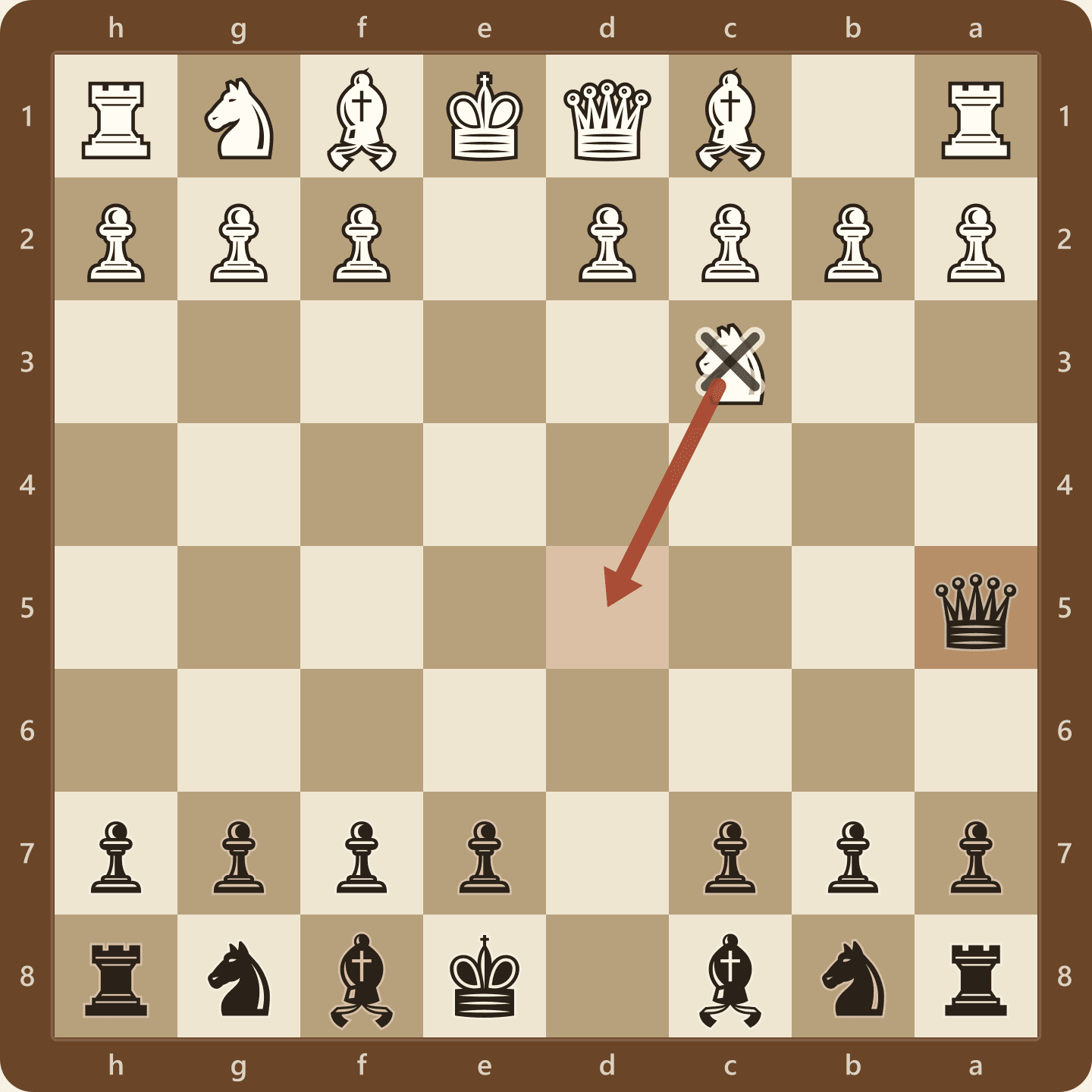
The Sicilian Defense is the most popular reply in the world and the largest body of theory in chess, which is a bad combination for a first repertoire. Against 1.d4, the Queen's Gambit Declined, the Nimzo-Indian Defense and the King's Indian Defense are the standard three, in roughly that order of memory demanded.
Sizing all three to your real weekly study time is its own job: how to build a chess opening repertoire.
Step 2 in practice: what "learn the idea" actually means
Three examples. Every diagram on this site is played out with a chess library before it is drawn, so the position you see is the position the notation describes.
Start with the Italian Game, 1.e4 e5 2.Nf3 Nc6 3.Bc4.
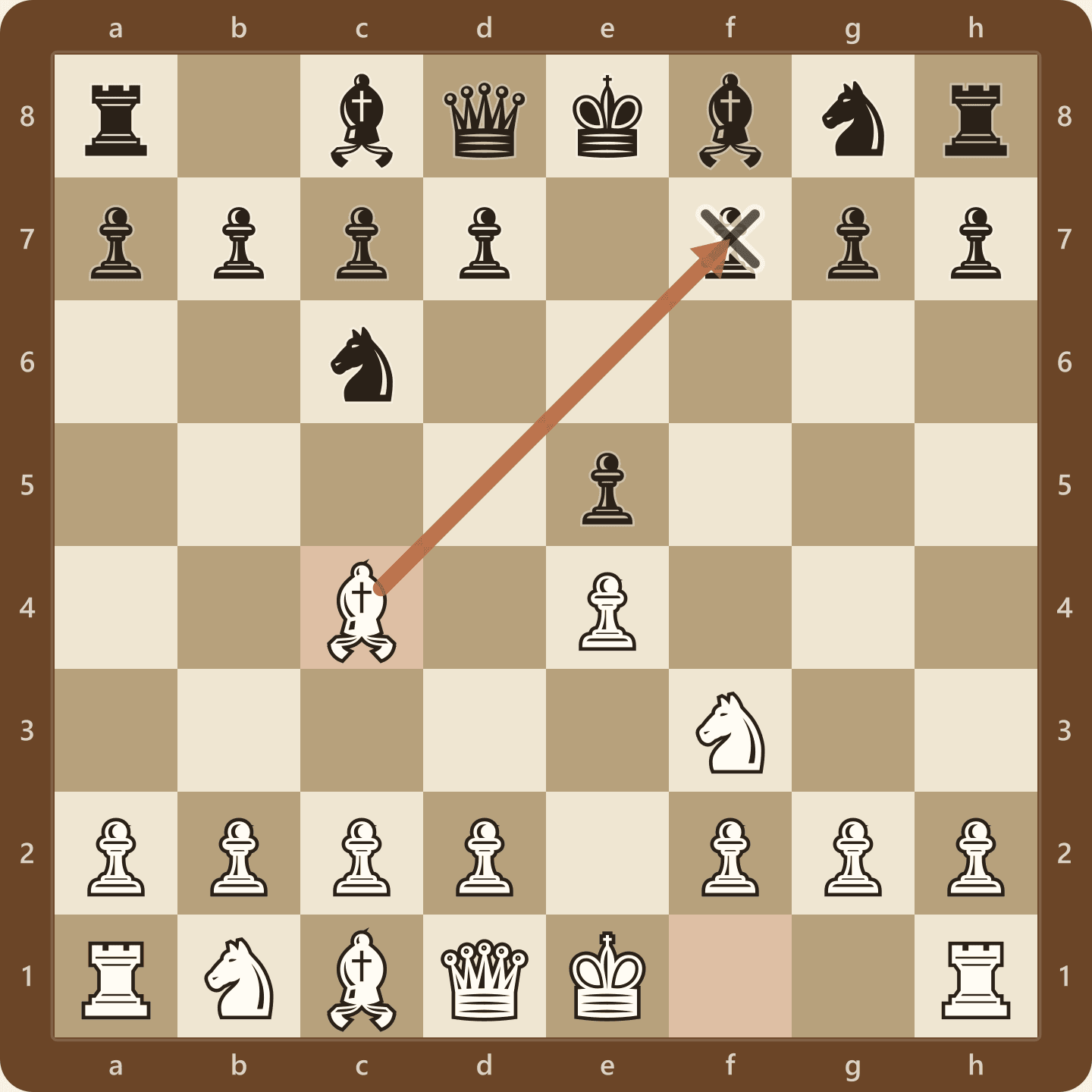
The idea is not "bishop goes to c4". The idea is that f7 is defended by exactly one piece at the start of the game, and White is building toward it. Once you know that, you understand why the knight often follows to g5, why Black plays ...Bc5 and ...Nf6 to fight for the center instead of just defending, and what a d2 to d4 push is for. That one sentence replaces about four moves of memory.
Now the London System, 1.d4 d5 2.Nf3 Nf6 3.Bf4.
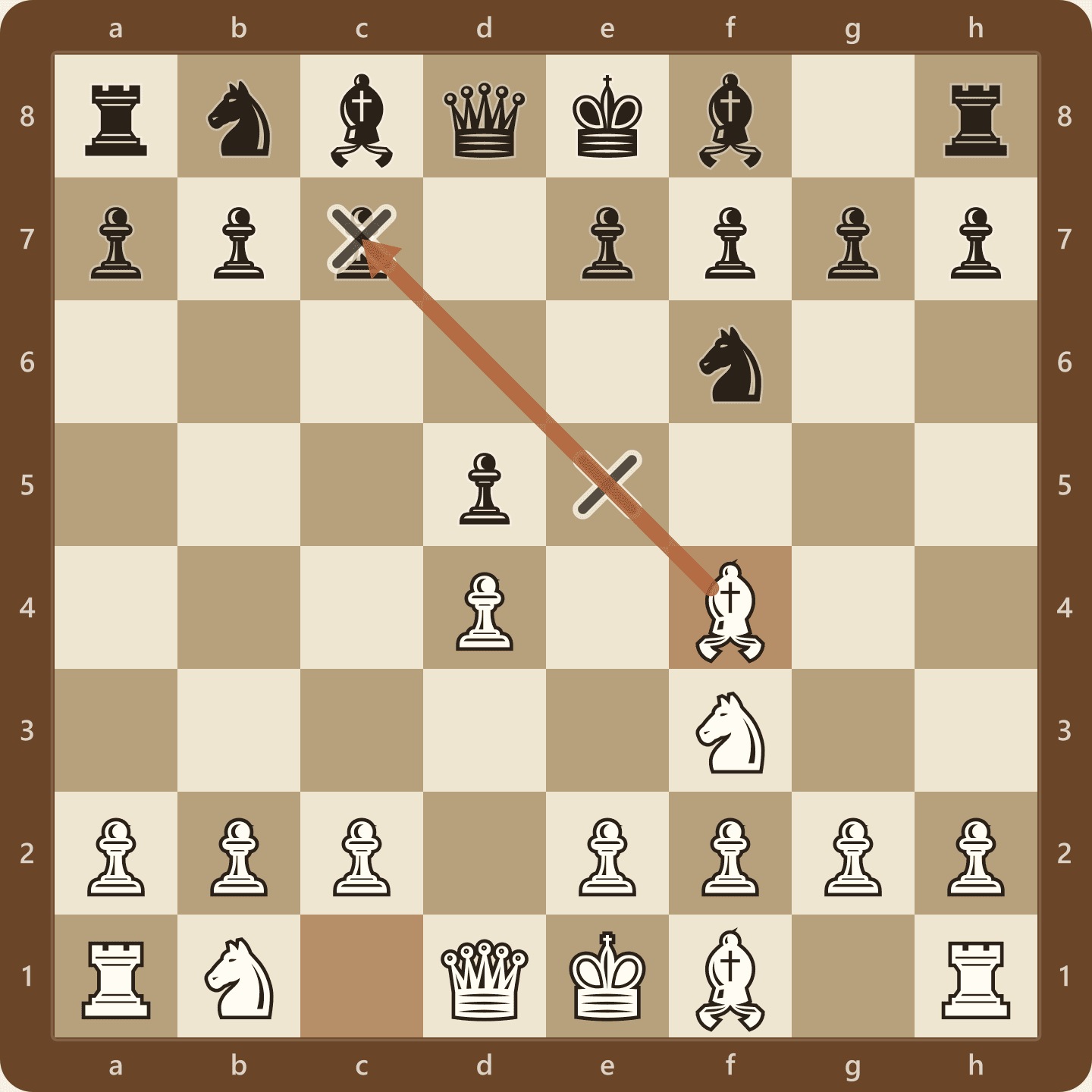
The London gets mocked, some of it deserved (here is why), but the reason it works for busy players is one structural idea: the dark-squared bishop leaves the house before the e3 pawn locks it in. Every London game is White building the same little machine (pawns on d4 and e3, bishop on f4, knight to d2, bishop to d3) and then picking a side of the board to attack on. One setup, not twelve lines.
Third, the Caro-Kann Defense, 1.e4 c6 2.d4 d5, shown from Black's side because that is the side you would be playing.
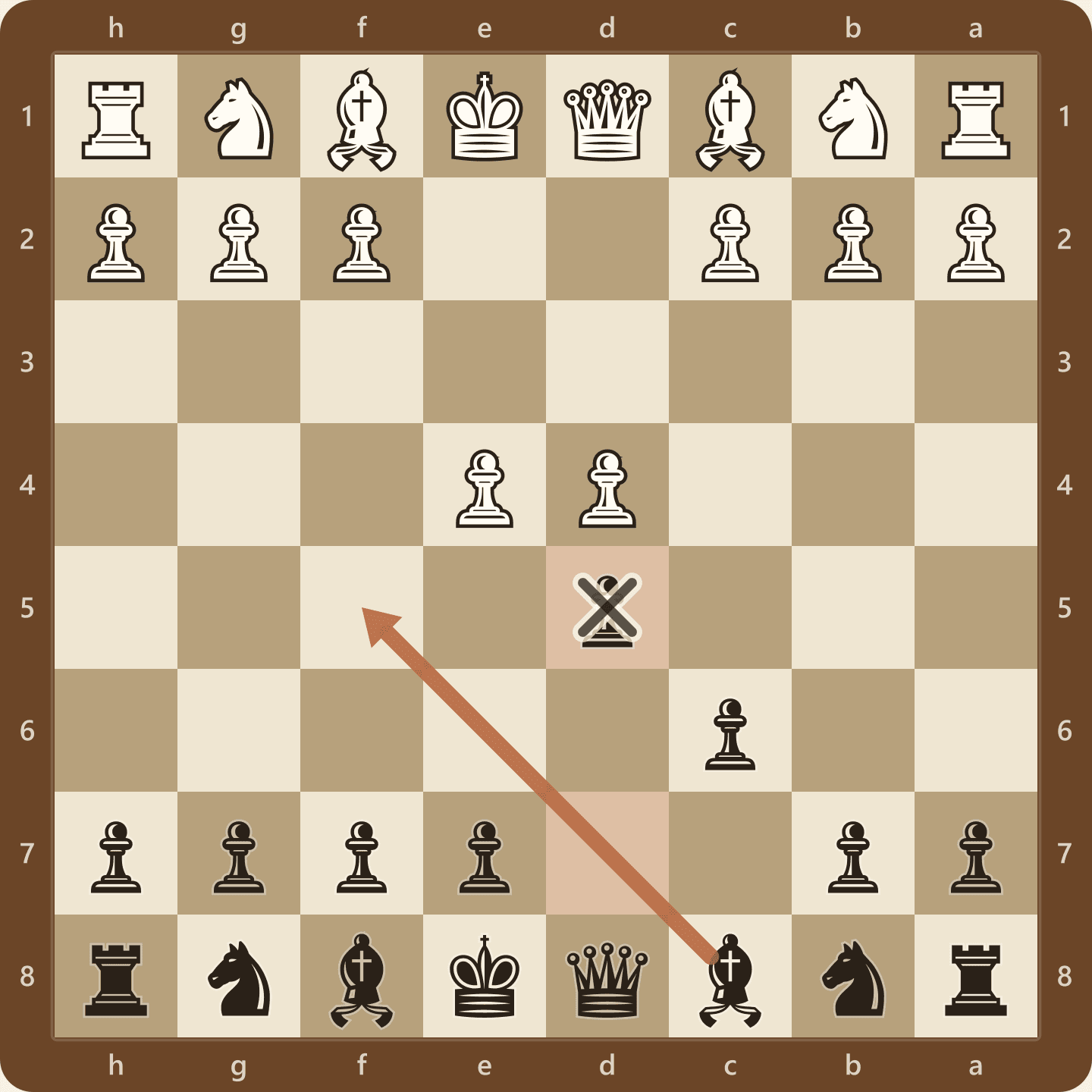
Black challenges the center with ...d5 and supports it with a pawn from c6 rather than from e6. That single choice is the entire difference between the Caro-Kann and the French Defense, because in the French the ...e6 pawn stands in front of the light-squared bishop and Black spends the next twenty moves trying to free it. Know that, and you can play both openings' early moves without a card in front of you. We compare them properly in Caro-Kann vs French Defense.
Notice what all three explanations have in common. No move counts. Just what the pieces are trying to do. If you can say it out loud, you can rebuild the moves from it, which is a sturdier form of memory than a list.
Step 4 in practice: find the exact move where you left the book
This is the step almost nobody does, and it is the one that turns playing into studying.
Take a game you lost and step through it from move one. You are not looking for the blunder, you are looking for the first move where you had no reason, just a vibe. Here is a typical one from the Italian: 1.e4 e5 2.Nf3 Nc6 3.Bc4 Bc5 4.c3 Nf6 5.d4.
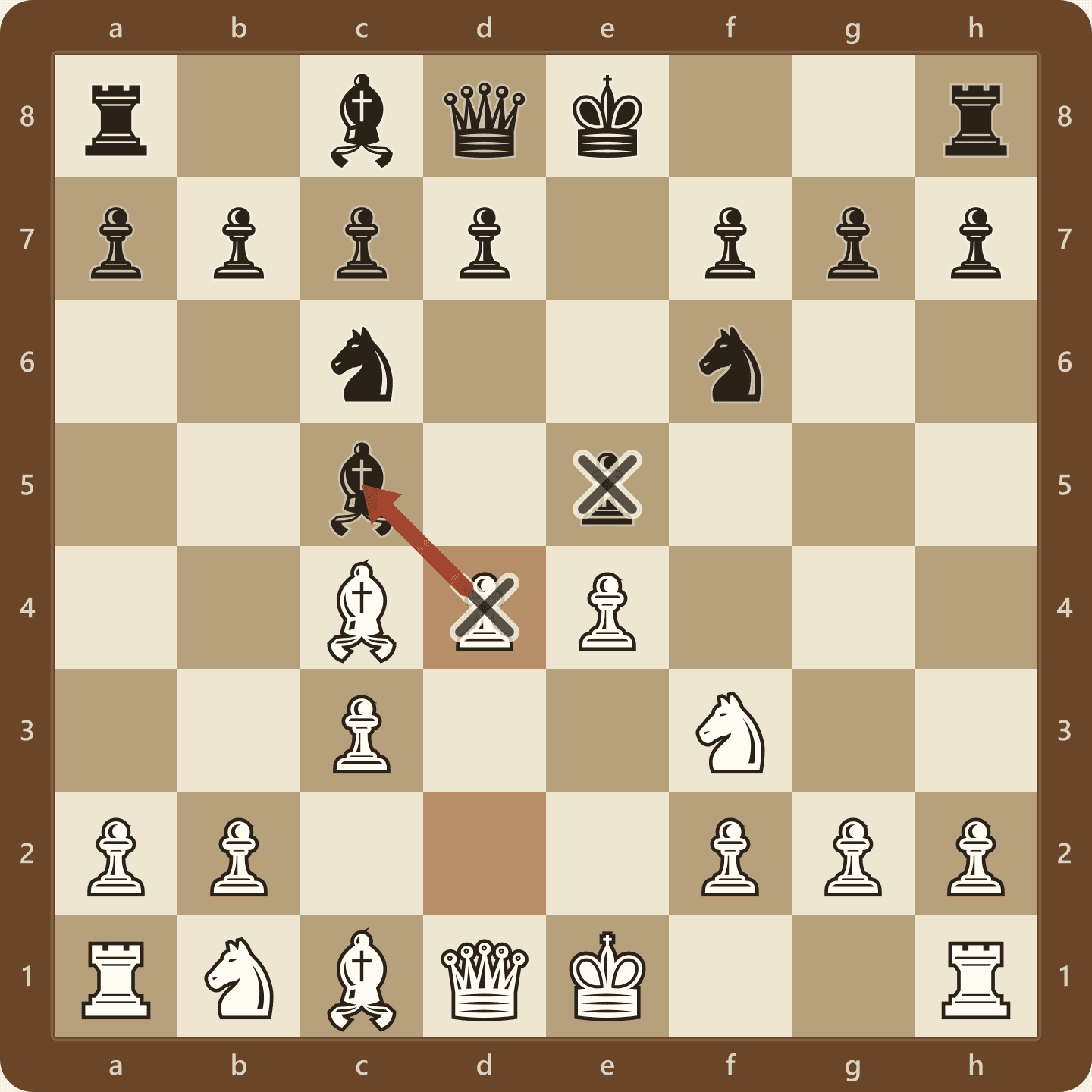
Black has real choices here and none of them are obvious to an improving player. That is a departure point, and it is worth one card. What is not worth a card is the move fourteen tactic you missed, because that is a tactics problem wearing an opening costume.
Two tools do the finding for you. The Lichess opening explorer shows how often a position has occurred in real games at your rating band, so the move where the game count collapses is roughly where you and your opponent both left known territory. Chess.com's Game Review labels the departure point directly. Either takes about thirty seconds per game.
Do not skip straight to the engine. Stockfish, the open-source engine behind the analysis on both sites, will happily tell you the best move was a queen sacrifice on move thirteen, which is true, useless, and not why you lost. Use the engine to check the answer after you have decided what the question was.
Reading databases without fooling yourself has real traps in it, especially around sample size. That is a whole article: how to use a chess opening explorer.
Step 5 in practice: spaced repetition without turning it into homework
Spaced repetition means reviewing a position at growing intervals, so you see it again just before you would have forgotten it. It is the most efficient way to hold opening moves in memory and the easiest thing in chess to overdo.
Two rules keep it sane. Cap the deck at roughly forty positions per opening, and never add a card you cannot explain in one sentence. A card you cannot explain is one you will get right for two weeks and then fail forever. Chessable does the scheduling for you; a calendar reminder does it for free.
| Tool | Cost | Best for | Watch out for |
|---|---|---|---|
| Lichess studies and explorer | Free, no tiers | Building and drilling your own repertoire | You organise it yourself |
| Chessable | Free and paid courses | Real spaced-repetition scheduling | Courses run far deeper than an improver needs |
| Listudy | Free, open source | Drilling a PGN file you already have | Sparse library, bring your own lines |
| Chessreps | Free tier, paid upgrade | Short prebuilt repertoires | Community course quality varies |
| Chess.com Game Review | Paid membership | Finding departure points automatically | Lessons are broad rather than deep |
| Anki | Free on desktop and Android | People already using it for something else | No board, no engine, screenshots by hand |
If you want the free-only path: Lichess studies for your repertoire, the Lichess explorer to find departure points, Listudy to drill. That covers everything on this page for nothing. We compare the two big platforms in general on Chess.com vs Lichess.
Learn the traps aimed at you, and only those
Traps are the exception to "ideas over moves", because a trap is a memory problem by design. Losing in eleven moves to something everyone else apparently knows is the fastest way to quit an opening you never gave a fair chance.
The efficient version: learn the two or three traps that live inside your own openings, from both sides, and ignore the rest. If you play 1.e4 e5 you need Scholar's Mate, the Fried Liver Attack and the Stafford Gambit. If you play the London you need almost none of them. Our full list is 15 chess opening traps, and it is a list to skim once, not to memorize.
Five ways improving players waste study hours
- Switching openings after a loss. You lost to a tactic on move nineteen. The opening was fine. Give any opening fifty games before you judge it.
- Counting YouTube as study. GothamChess and the rest are genuinely good and genuinely entertainment. Watching a video about the Najdorf is not the same as being able to play it, and only one of those costs you effort.
- Studying both of White's first moves. Learning 1.e4 and 1.d4 at once doubles the work and halves the repetition on each.
- Going deep before going wide. A line memorized to move eighteen is worth nothing if a sideline on move three still stops you cold.
- Studying without playing. Cards you have never used in a real game decay fast. The play is what makes the review stick.
When should you start on openings at all?
If you are still hanging pieces in one game out of two, opening study is not your bottleneck and no repertoire will save you. Tactics and basic endgames pay off in every game rather than the first ten moves.
The honest threshold: once you regularly reach a middlegame with equal material and no idea what to do, you are ready, because now the opening decides which middlegame you get. Fuller answer on how much opening theory do you actually need.
The short version
Three openings. One sentence of intent per opening. Rapid games, not blitz. Find the first guessing move in each loss, make one card, review twice a week. Nothing there asks you to memorize a line, and the memory you do end up with is attached to a reason, which is why it will still be there next month.
Our complete guide to chess openings is the map of how these openings connect. For the drilling side, read how to practice chess openings. If algebraic notation still slows you down, fix that first with chess notation explained.