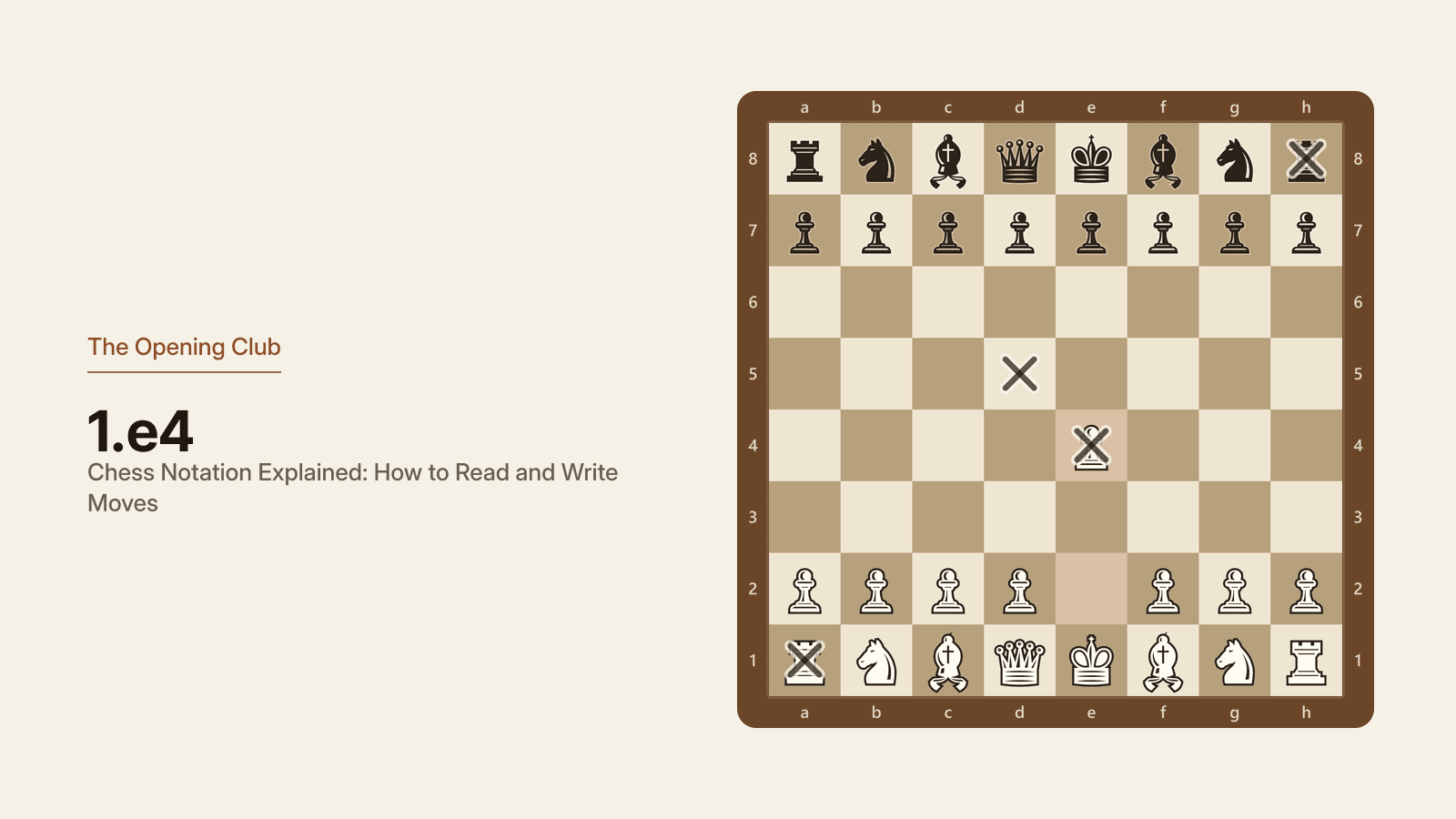
Chess notation is the written system for recording moves. Modern algebraic notation names every square with a file letter (a to h) and a rank number (1 to 8), then writes each move as the moving piece's letter plus its destination square. So 1.e4 means a pawn moved to the e4 square.
That is the whole idea. Everything else is a handful of extra marks for captures, castling, check and promotion, and you can learn all of them in about ten minutes. Each one below comes with a diagram, because reading a move sequence and seeing the position it produces are two different skills.
Every square has a name
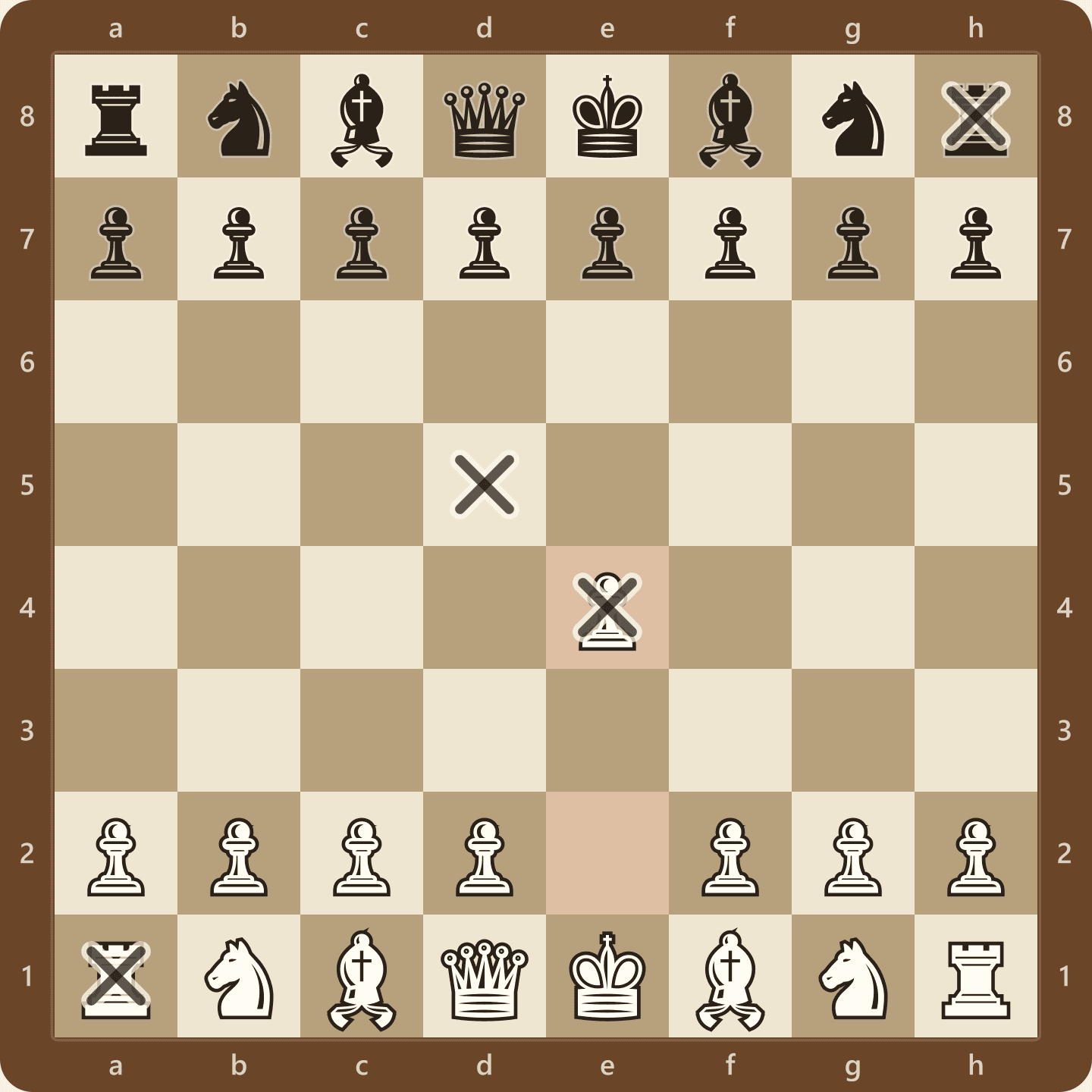
The board's vertical columns are files, lettered a to h from White's left to right. The horizontal rows are ranks, numbered 1 to 8 starting from White's side of the board. A square's name is its file letter followed by its rank number, lower case, always in that order.
Two things catch people out. The names never flip: e4 is e4 whether you are playing White or Black, so from Black's side of the board a1 is the far corner on your right. And the letter always comes first. It is e4, never 4e.
The piece letters
Every piece except the pawn gets one capital letter. The letters are picked so that no two collide, which is why the knight is N.
| Piece | Letter | Note |
|---|---|---|
| King | K | Kf1, Kxe2 |
| Queen | Q | Qd8, Qxf7 |
| Rook | R | Re1, Rxd4 |
| Bishop | B | Bc4, Bxc6 |
| Knight | N | K was already taken by the king, so the knight borrows its second letter |
| Pawn | none | A pawn move is written as the destination square on its own: e4, d5, h6 |
Those letters are English. A German book writes the knight as S for Springer, a Spanish one writes C for caballo. To avoid that problem entirely, international publications use figurine notation, which swaps the letter for a small picture of the piece so the moves read the same in any language. That convention was popularised by Chess Informant, publishing annotated games since 1966.
Writing an ordinary move
A game is written as a numbered list. The move number comes first, then White's move, then Black's reply.
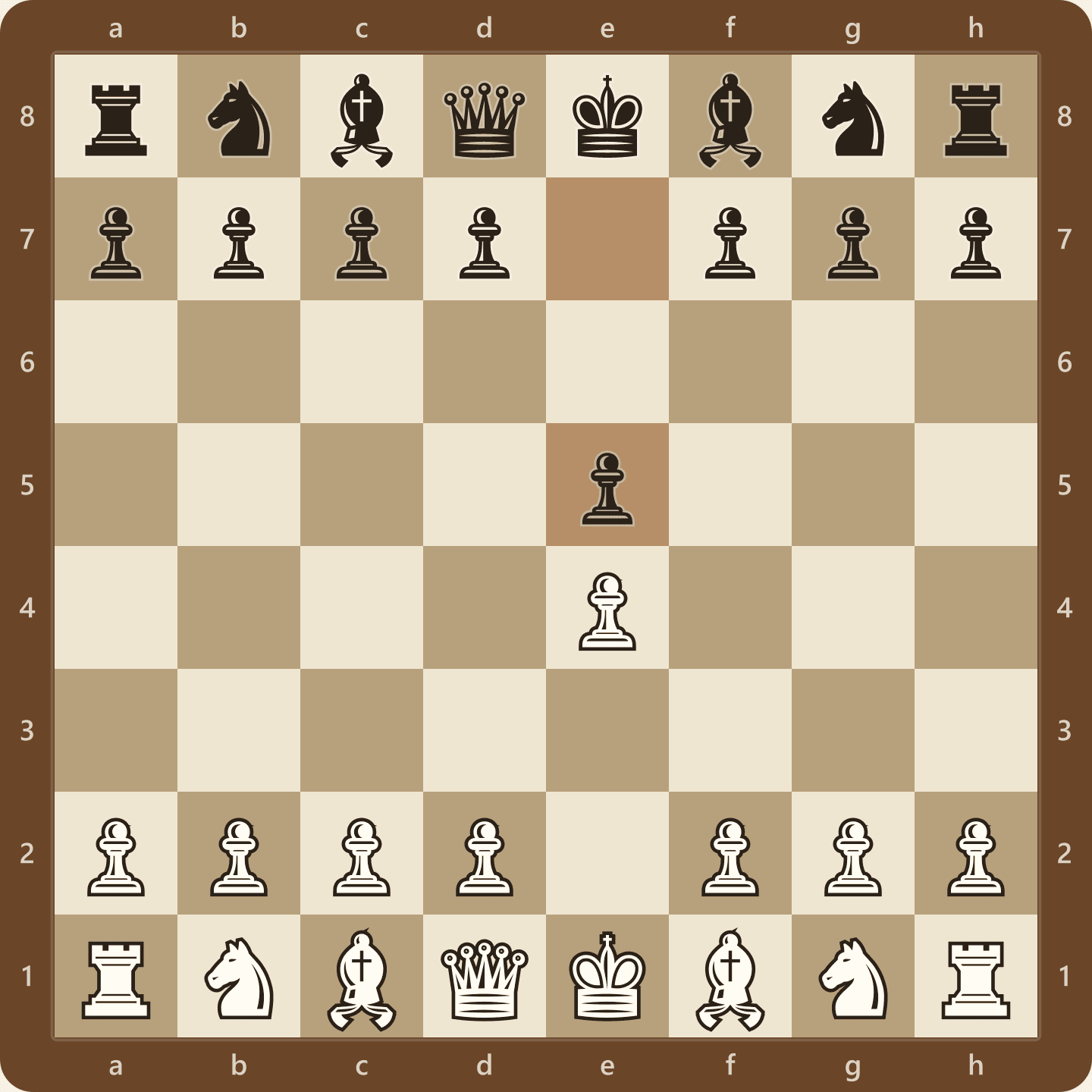
1.e4 e5 means White pushed the e-pawn to e4 and Black answered by pushing the e-pawn to e5. One number, two moves.
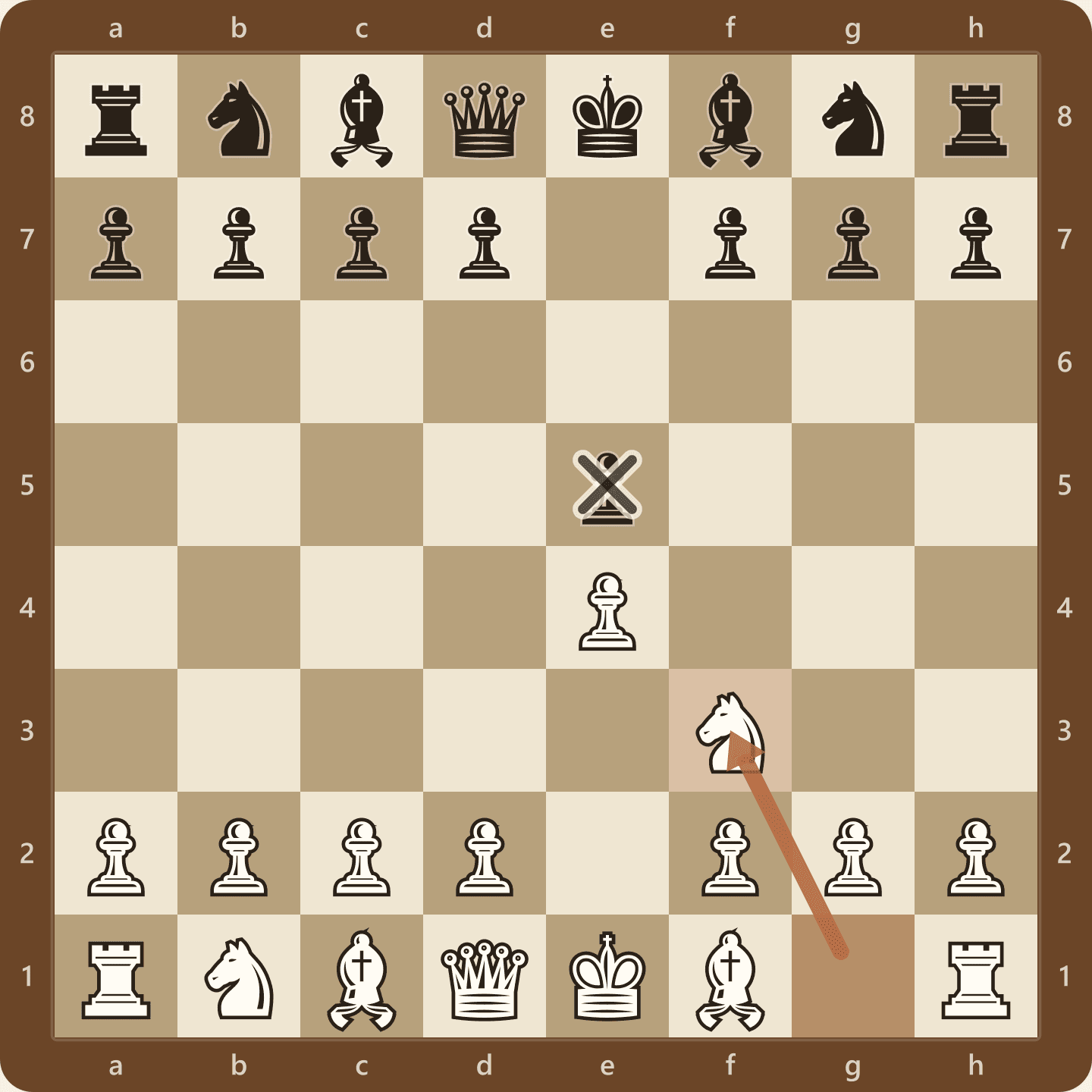
A piece move is the letter plus where it lands. 2.Nf3 is a knight to f3, and because only one white knight can reach f3, that is all the information anyone needs.
When a black move gets quoted on its own, it takes three dots: 2...Nc6. The dots exist so you can tell 4.Bc4 (White's fourth move) from 4...Bc5 (Black's fourth move) when only one of them is printed.
Captures use x
An x goes between the piece and the destination square. A bishop taking on c6 is Bxc6. A queen taking on f7 is Qxf7.
Pawns have no letter of their own, so a capturing pawn is identified by the file it came from. A pawn on e4 taking on d5 is written exd5.
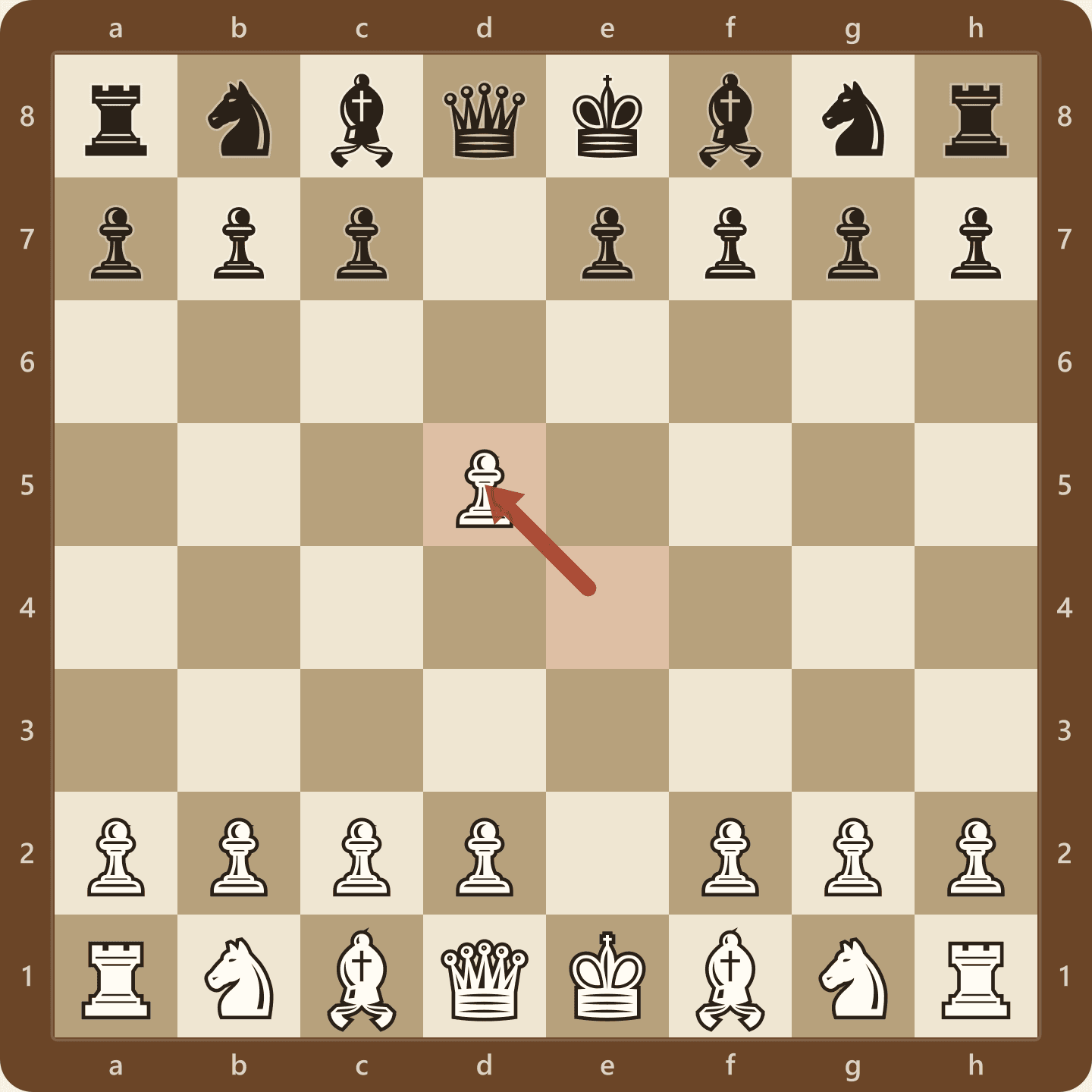
This is where the search query "what does dx mean in chess" comes from. dx is not a move, it is half of one: a pawn on the d-file making a capture, as in dxe5 or dxc4. Older books shorten it further to ed or ed5.
When two pieces could reach the same square
If two identical pieces can legally move to the same square, the notation adds just enough to tell them apart, in this order: the file letter first, the rank number if the file does not settle it, and the full starting square if neither does.
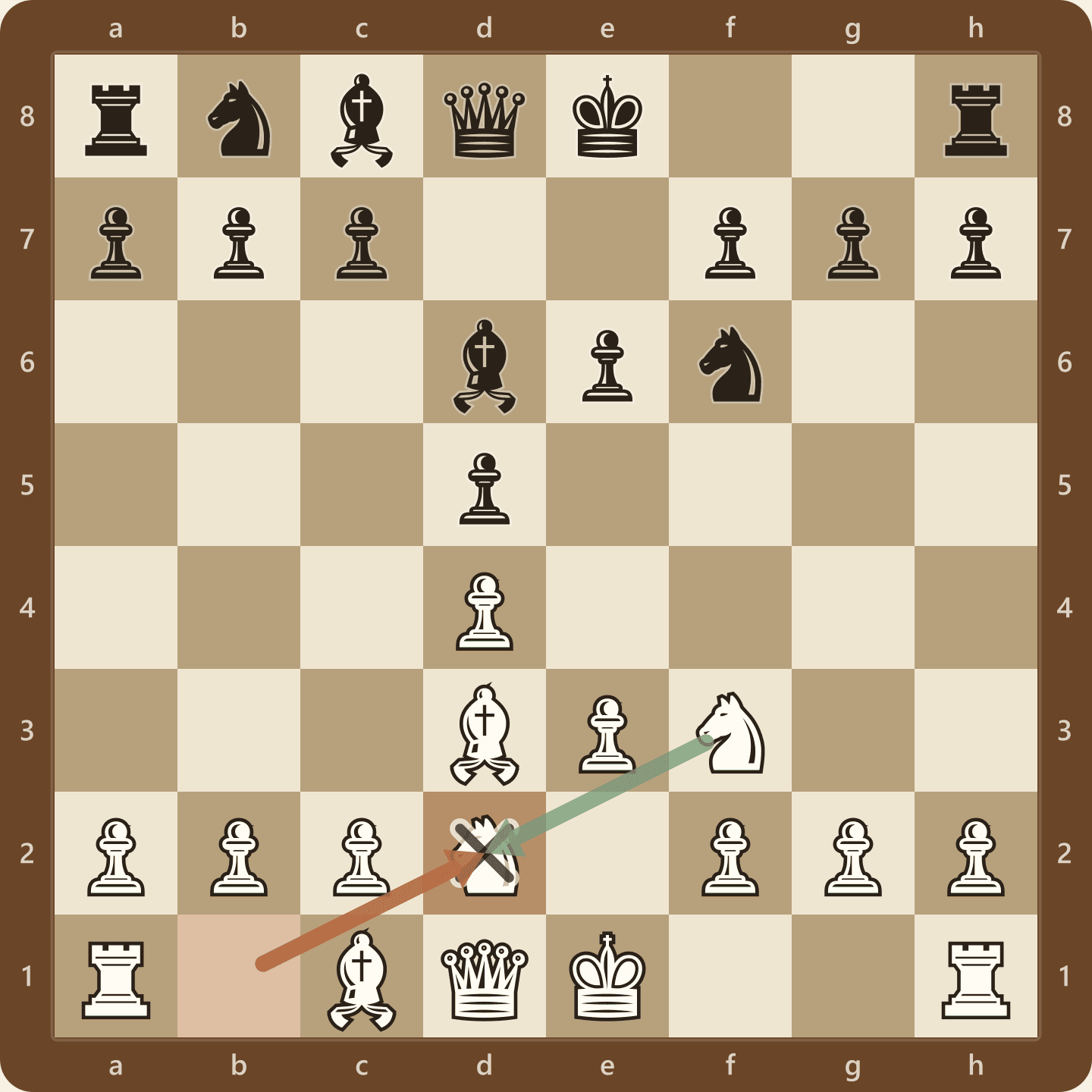
Rooks generate this constantly, which is why Rae1 and R1d2 show up so often. A stray letter in the middle of a move is always doing this job.
Castling: O-O and O-O-O
Castling is the one move that does not name a square, because it moves two pieces at once.
O-O is kingside castling, sometimes called short castling. The king goes two squares toward the h-file and the rook hops over it.
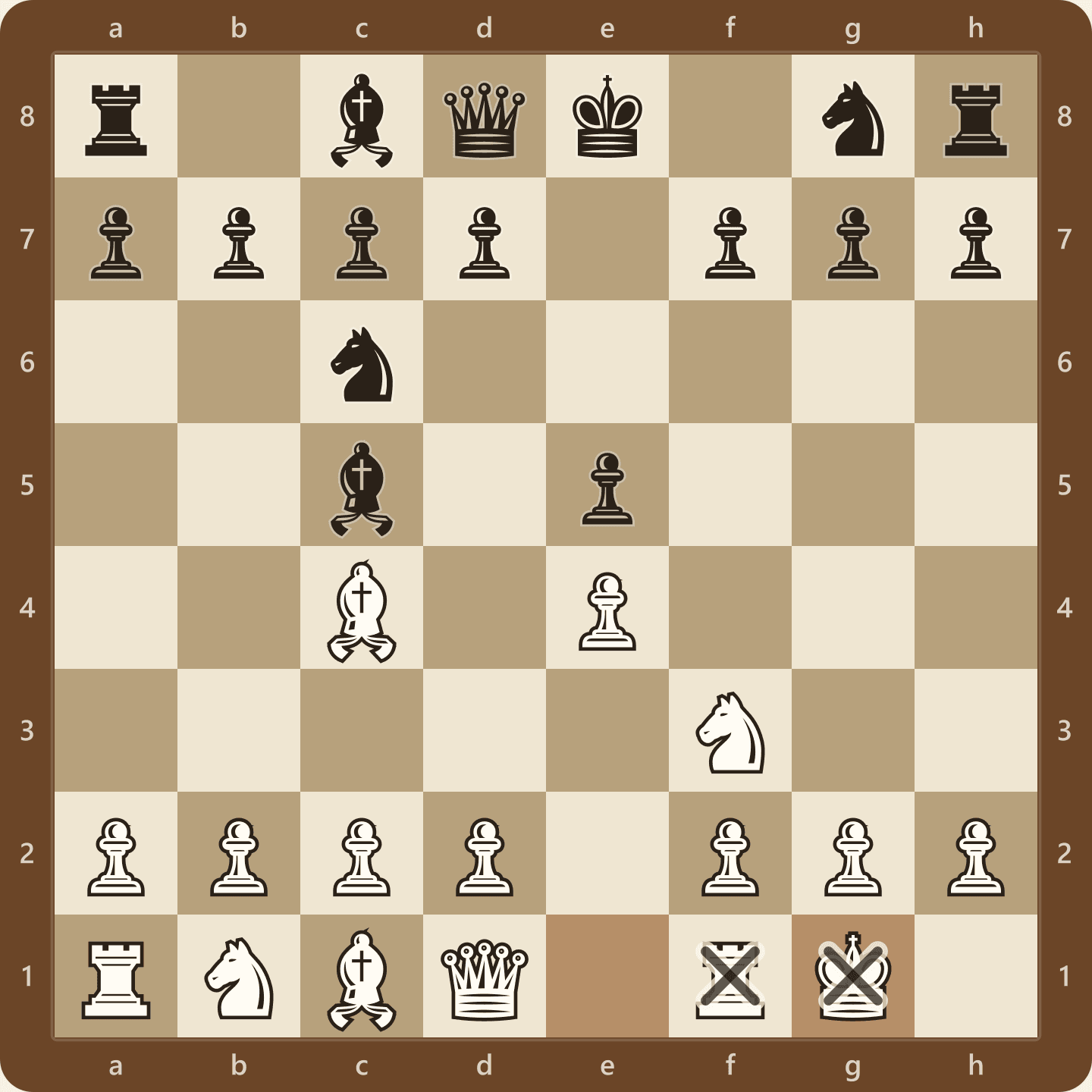
O-O-O is queenside castling, or long castling. Same move, other side, and the rook travels further.
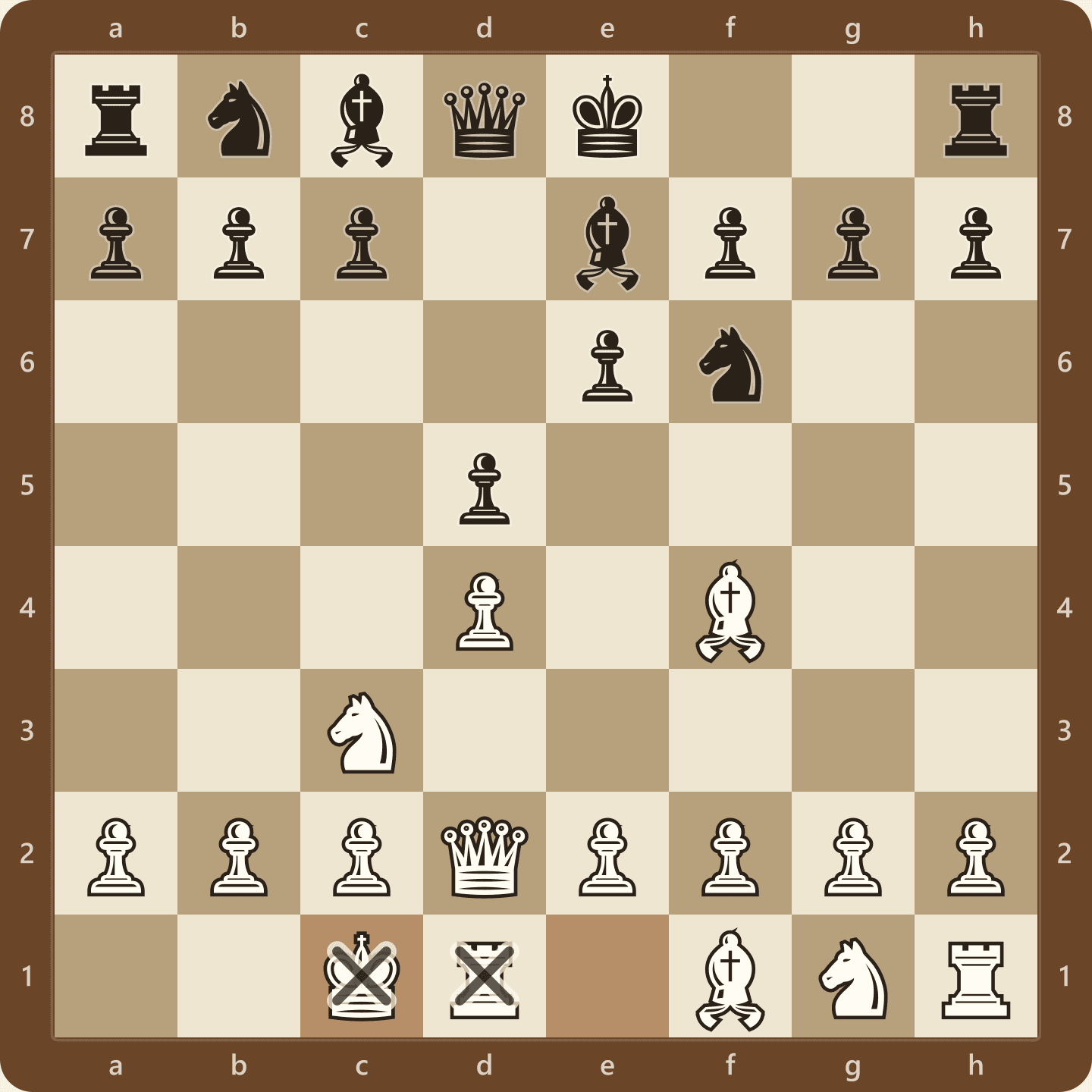
The mnemonic is that the longer trip gets the longer symbol. Those are capital letter O officially, though plenty of books print them as zeros (0-0 and 0-0-0). Both mean the same thing.
Check, checkmate, and what ++ means
A + after the move means check.
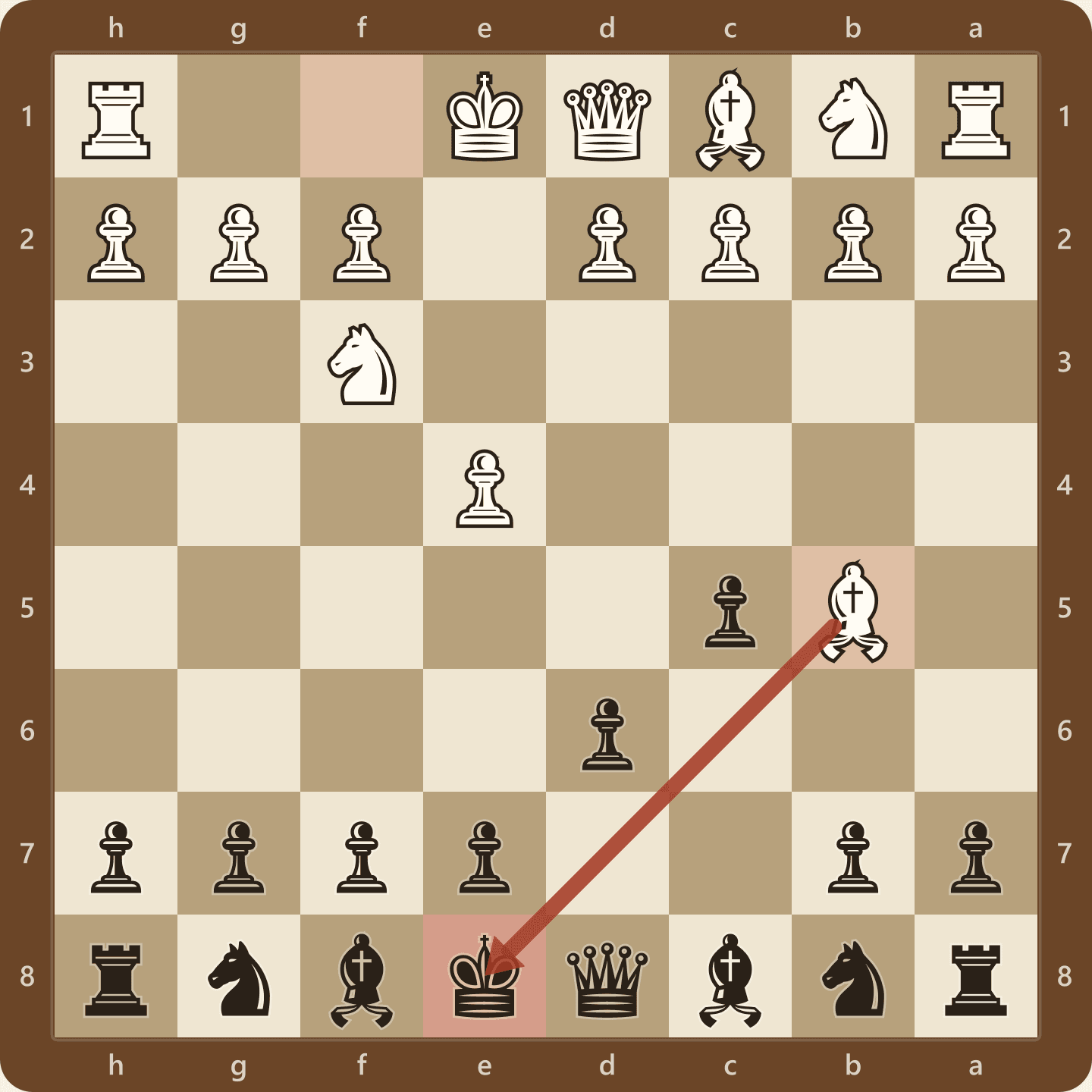
A # means checkmate. Older books write checkmate as ++ or spell out mate, and you will still meet that in reprints.
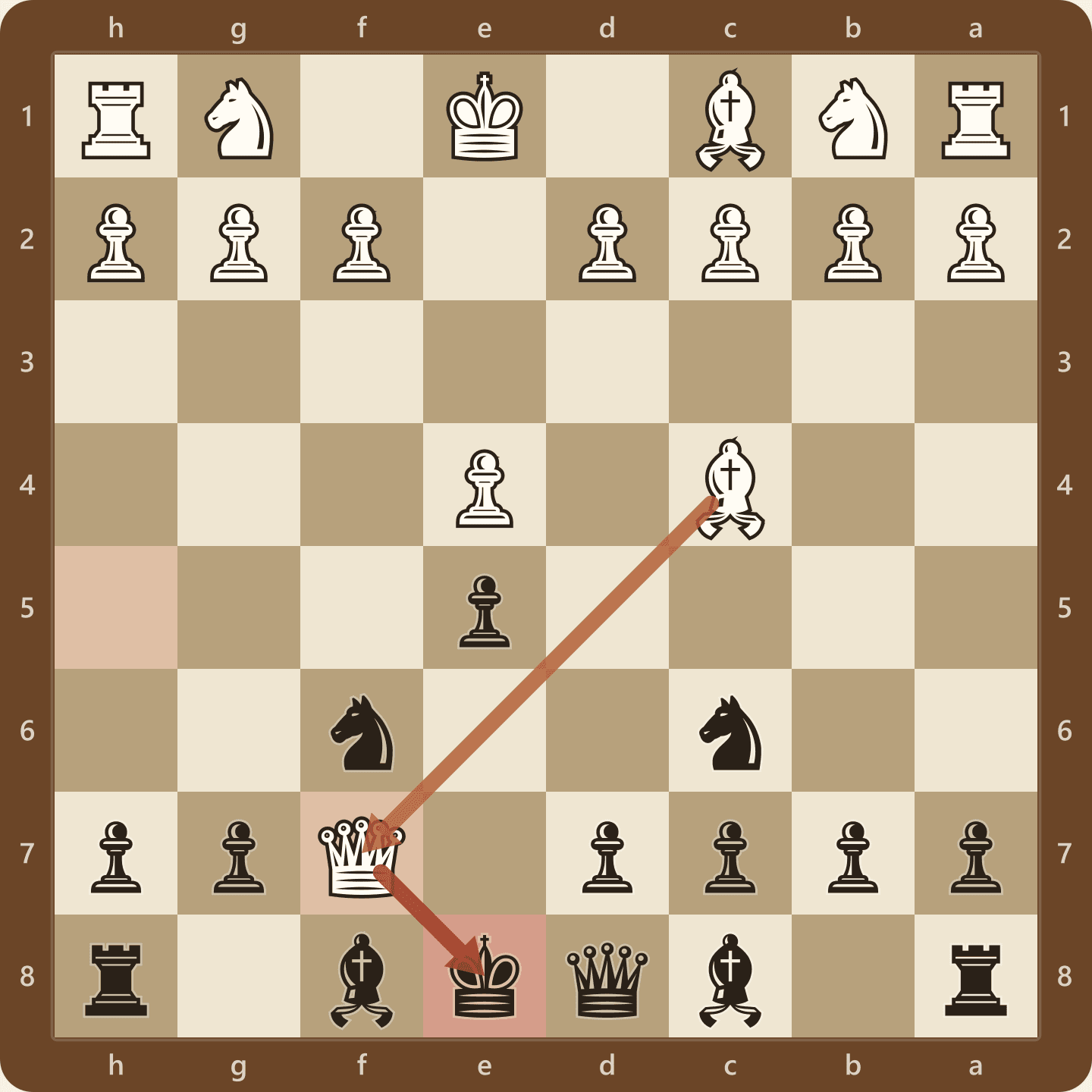
In modern books ++ usually means double check, where a single move exposes the king to two attackers at once. Context tells you which is meant: if the game continues after it, it was a double check. The mate above is the finish of Scholar's Mate, and its two-move cousin lives at Fool's Mate.
Promotion and en passant
Promotion is written as the pawn's move, then = and the letter of the new piece. b8=Q is a pawn reaching b8 and becoming a queen. Choosing a knight instead is b8=N, and that underpromotion is worth knowing because it occasionally comes with check.
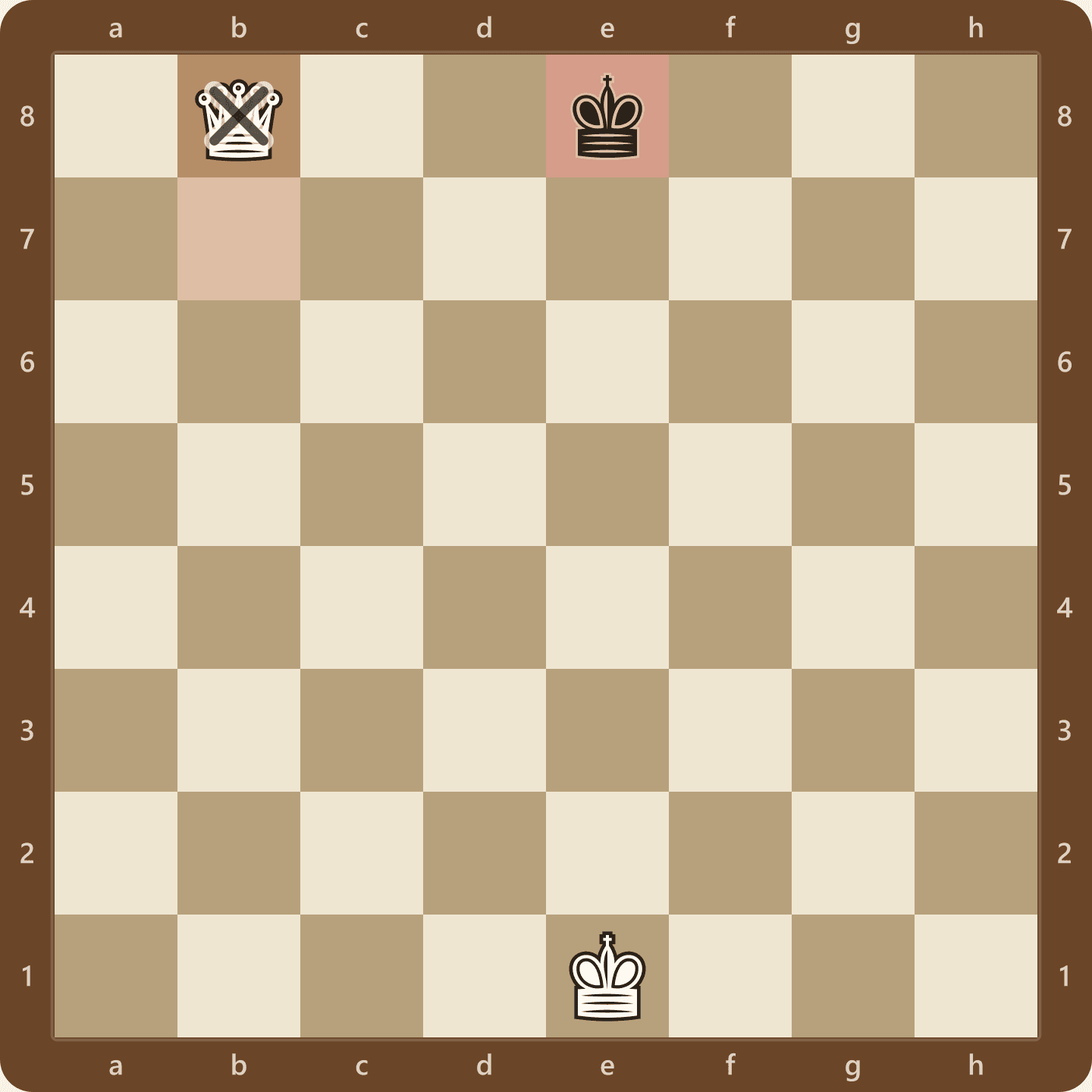
En passant, the capture where a pawn takes an enemy pawn that has just run past it, gets no special symbol at all. It is written like any other pawn capture, occasionally with e.p. tacked on.
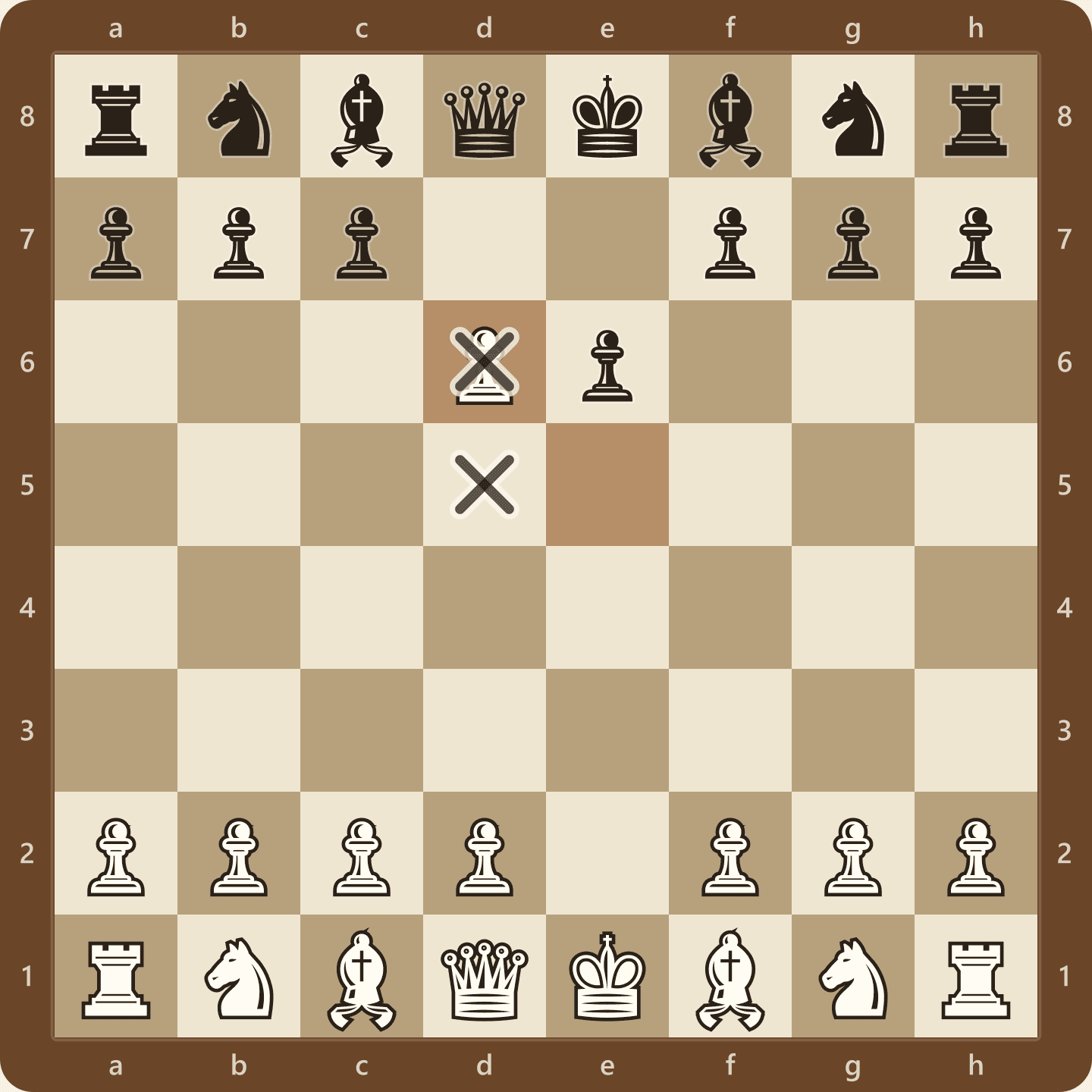
That gap between the square in the notation and the square the captured pawn was on is the most common reason a beginner thinks a game score is corrupt. It is not.
The symbols after the move
The marks that follow a move are opinion, not fact. They are the annotator telling you what they thought of it.
| Symbol | Name | What it is telling you |
|---|---|---|
| ! | Good move | Hard to find, and it works |
| !! | Brilliant move | Usually a sacrifice whose point only shows up several moves later |
| ? | Mistake | Throws away a real part of the advantage |
| ?? | Blunder | Loses material or the game outright |
| !? | Interesting move | Risky, probably not the engine's choice, but practically awkward to face |
| ?! | Dubious move | Playable, but the annotator would not repeat it |
| = | Equal | Neither side is better |
| +/- and -/+ | Clear advantage | White or Black respectively |
| 1-0, 0-1, 1/2-1/2 | Result | White won, Black won, draw. In a PGN file an unfinished game ends with an asterisk |
!? and ?! are the pair worth internalising, because they carry the most information. !? is roughly "I would not play this, but good luck to whoever has to meet it over the board", which is exactly the profile of most club-level gambits. The ranking of these symbols is not a chess rule, it is an editorial convention that Chess Informant standardised, and different annotators apply it differently.
What the engine means when it labels your move a blunder rather than a mistake is a different scale entirely, and it gets its own page: what is a blunder in chess.
How a whole game gets written down
Over the board, you write moves by hand on a scoresheet, a numbered grid with a column for White and a column for Black. FIDE's Laws of Chess require players in a rated game to record every move, and the U.S. Chess Federation rulebook says the same. Algebraic is the only system FIDE recognises.
Online, the recording happens for you. What you get back is PGN, or Portable Game Notation, the plain-text file format every chess site and program reads. A PGN file is a block of tagged information (event, date, players, result) followed by the moves in exactly the algebraic notation described above. Copy a PGN out of Chess.com or Lichess, paste it into Lichess's import page, and you get a replayable board. That single trick is most of what notation is good for at club level. Which site you are copying it from barely matters, though Chess.com vs Lichess covers the differences that do.
One more system exists for a specific reason. ICCF numeric notation, used in international correspondence chess, replaces letters with numbers so that language never comes into it: files a to h become 1 to 8, so e2 is 52, e4 is 54, and the move 1.e4 is written 5254.
The old notation, and long algebraic
If you pick up an English-language chess book printed before about 1980, the moves will look nothing like this. That is descriptive notation, where squares are named relative to each player's own pieces. 1.P-K4 means "pawn to king four", and king four is e4 for White but e5 for Black. Every square therefore has two names depending on who is moving, which is exactly as confusing as it sounds. FIDE retired it, and the answer to "what is the old chess notation called" is descriptive notation.
Long algebraic is the friendlier middle ground: it writes both the starting and the finishing square, so 1.e4 becomes 1.e2-e4 and Nf3 becomes Ng1-f3. It is longer to write but almost impossible to misread, and it is what most chess engines use internally. If short algebraic is still slow going, most sites will switch your move list to the long form while you learn.
An early version of the algebraic system appears in the 1737 book by Philipp Stamma, a Syrian-born player working in Europe, which makes the "modern" notation older than the descriptive one it eventually replaced.
Why record your games at all
Online, you do not have a choice, and that is the point. Every game you play is already stored in notation, which means every game is reviewable. The improving player's loop is:
- Lose a game.
- Open it in the site's analysis board and find the first move the engine marks with a
?or??. - Work out what you were actually looking at when you played it.
- Note the position, not the move.
Step four is where the value is. A move you memorise is worth one game. A position type you recognise is worth hundreds. Our guides to using an opening explorer, how much opening theory you actually need and chess opening principles pick up from here.
Every diagram on this page was played out move by move with a chess engine library before rendering, so the position you see always matches the notation printed beside it. That is not a flourish. It is the only way to be sure that a guide about notation does not contain a typo in its notation.
Frequently asked questions
What does O-O-O mean in chess?
Queenside castling, also called long castling. The king moves two squares toward the a-file and the rook that started on a1 (or a8 for Black) jumps to the far side of it. O-O with two letters is kingside castling. The longer symbol goes with the longer rook journey.
What does dx mean in chess?
It is the start of a capture by a pawn standing on the d-file, as in dxe5 or dxc4. Pawns have no piece letter, so notation identifies a capturing pawn by the file it came from. The letter before the x is a file, never a piece.
What is the ++ in chess notation?
In modern usage it means double check: one move that exposes the enemy king to two attackers at once. In older books it was the symbol for checkmate, where today's convention is #. If the game keeps going after ++, it was a double check.
How do you write check in chess notation?
Add a + after the move, so a bishop moving to b5 and attacking the king is Bb5+. Checkmate is #, as in Qxf7#. Nothing else about the move changes, and the plus sign is never used for anything other than check.
What is the old chess notation called?
Descriptive notation. It names squares relative to each player's own side, so 1.P-K4 means "pawn to king four". It was standard in English-language books until roughly 1980, when algebraic notation took over. FIDE now recognises algebraic only.
Do I have to write down my moves in a tournament?
In FIDE-rated and U.S. Chess Federation rated over-the-board games with a long enough time control, yes: both players keep a scoresheet in algebraic notation. There are exceptions for very fast time controls and for players with disabilities. Online, the site records it for you.
Why is the knight written as N and not K?
Because K was already assigned to the king, and the two pieces have to be distinguishable at a glance in a game score. The knight takes the next usable consonant. It is the single most common stumbling block for people reading their first game score.
The one thing to practise
Read a game score with a board in front of you and play the moves out. Not analysis, not annotations, just the moves. Ten minutes of that beats any explanation, because notation is a reading-speed problem rather than a knowledge problem. Once the letters stop needing a translation step, every guide here gets easier to use, starting with chess openings and the full list of opening names.