How many chess openings are there? The standard classification, the Encyclopaedia of Chess Openings, has exactly 500 codes running from A00 to E99. The most cited reference count of named openings and variations is 1,327. A full ECO-derived move database runs to several thousand named entries. Every one of those numbers is correct, because each counts a different thing.
Below is what each number counts, where it comes from, and why the total keeps growing without anybody inventing a new game.
The four answers, side by side
| The number | What it counts | Source |
|---|---|---|
| 20 | Legal first moves for White | Follows directly from the rules |
| 500 | ECO classification codes, A00 to E99 | Encyclopaedia of Chess Openings, Chess Informant |
| 1,327 | Named openings, variations and sub-variations | The Oxford Companion to Chess, 2nd edition 1992 |
| 3,810 | Named entries in a full ECO-derived move database | The Opening Club opening database, 9 August 2026 |
| about 4.8 x 10^44 | Legal positions reachable in chess | John Tromp's 2021 estimate |
If someone gives you a single number without saying which of those they mean, they are guessing.
Start with what is actually forced: 20
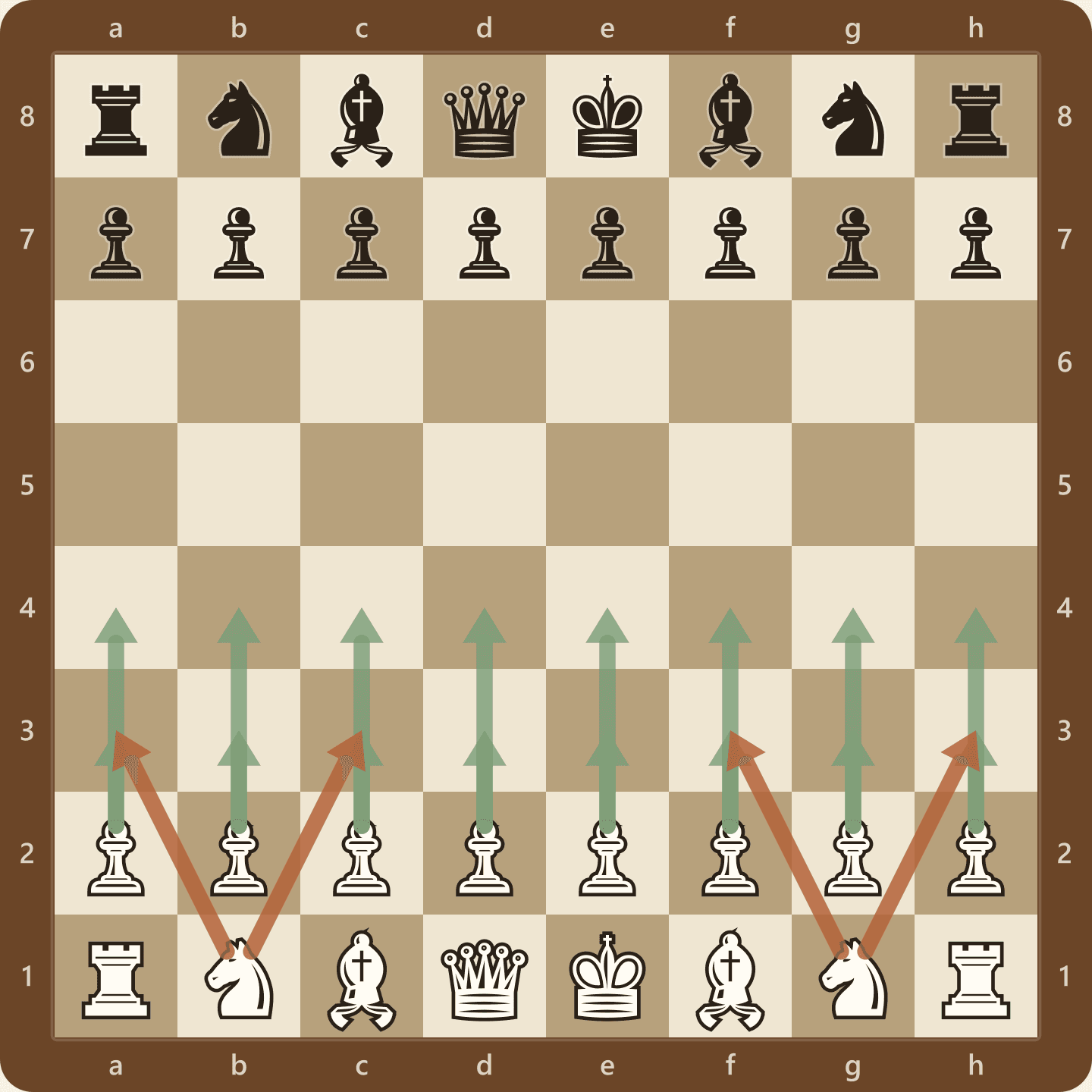
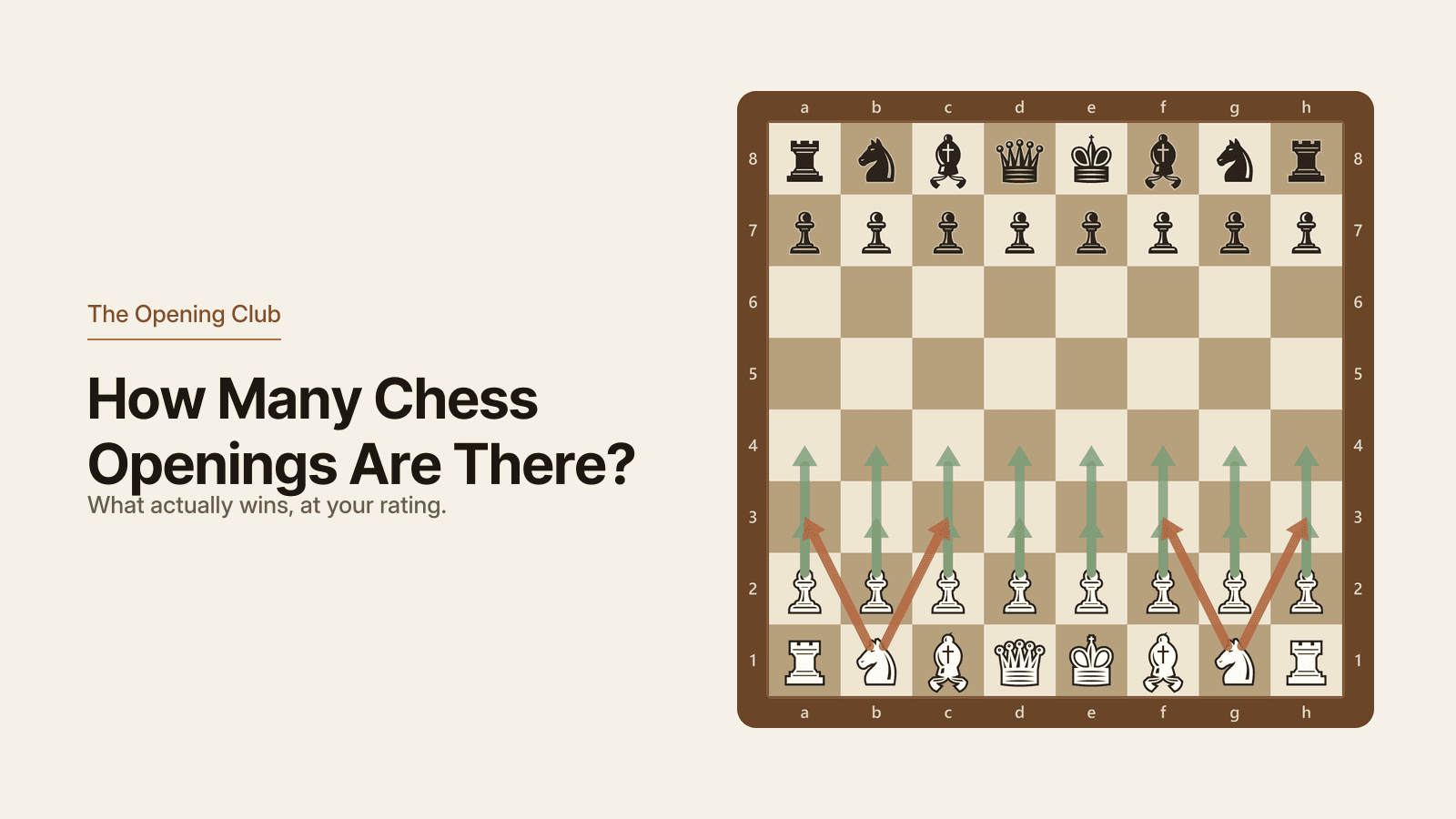
White has twenty legal first moves: each of the eight pawns can advance one or two squares, and each knight has two available squares. Five of those twenty carry serious names of their own. 1.e4 and 1.d4 dominate, 1.c4 is the English Opening, 1.Nf3 is the Réti Opening, and 1.f4 is Bird's Opening. The rest are playable and mostly unfashionable.
Black then has twenty replies, so after one move each there are 400 positions. That is where the counting stops being simple.
500: the ECO codes
The Encyclopaedia of Chess Openings, published by Chess Informant in Belgrade, is the classification everybody actually uses. The scheme is stated plainly: "There are five main categories, 'A' to 'E', corresponding to the five volumes of the earlier editions, each of which is further subdivided into 100 subcategories, for a total of 500 codes."
So the answer to "how many chess openings are there" in the sense of official categories is exactly 500, and they divide like this:
- A00 to A99, flank openings. The English Opening, Bird's Opening, the Réti Opening, the Dutch Defense, the Benoni Defense and the Benko Gambit.
- B00 to B99, semi-open games. Everything Black plays against 1.e4 except 1...e5 and the French: the Sicilian Defense, the Caro-Kann Defense, the Pirc Defense, the Scandinavian Defense, Alekhine's Defense.
- C00 to C99, open games and the French. The Ruy Lopez, the Italian Game, the Scotch Game, the Vienna Game, the King's Gambit, Petrov's Defense and the French Defense.
- D00 to D99, closed and semi-closed games. The Queen's Gambit, the Slav Defense, the Grünfeld Defense, the London System and the Trompowsky Attack.
- E00 to E99, Indian defences. The Nimzo-Indian Defense, the King's Indian Defense and the Catalan Opening.
A code is a bucket, not a line. C42 is not one opening, it is every position the classifiers decided belongs to Petrov's Defense.
3,810: how many actually have names
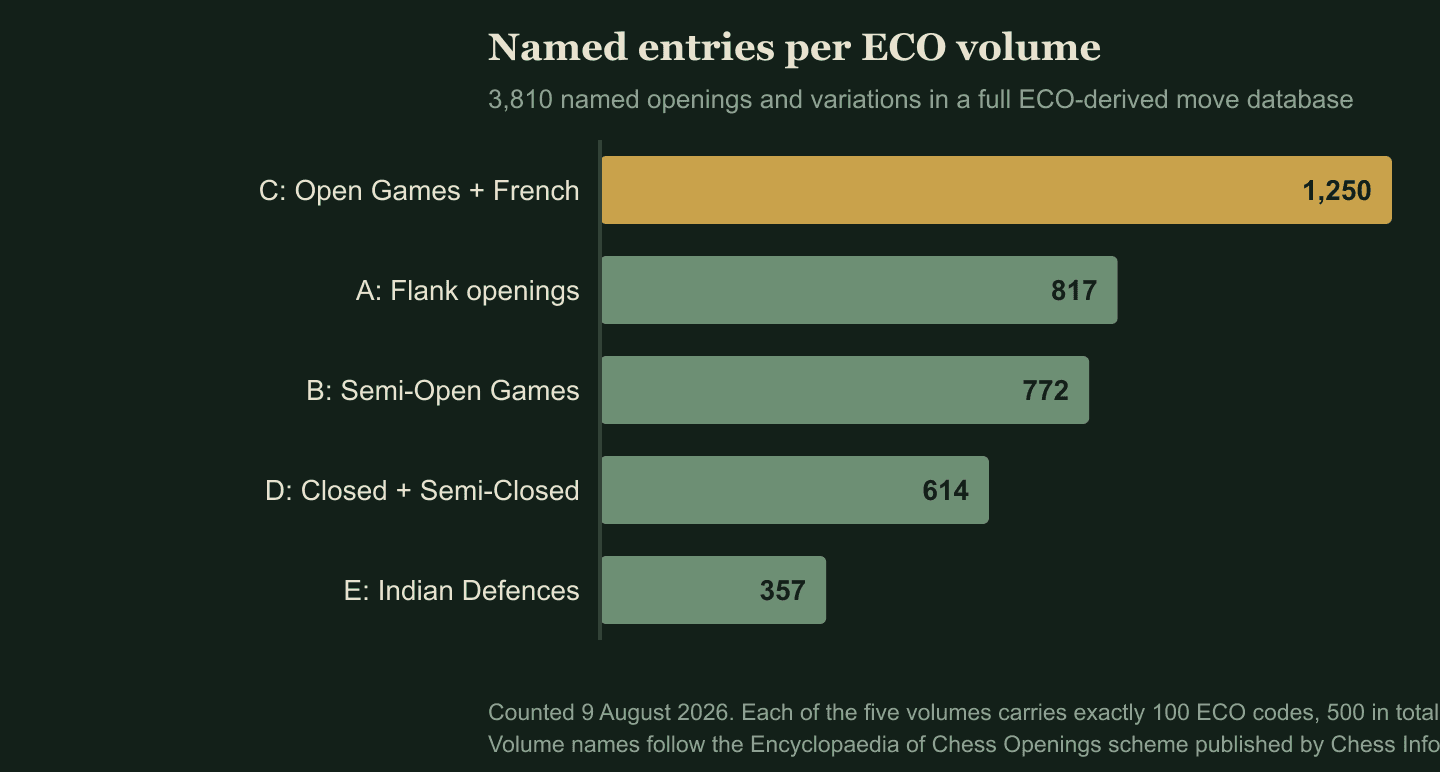
A full ECO-derived opening database, one that stores a verified move sequence for every named branch, runs to 3,810 entries. Counted on 9 August 2026, they split across the five volumes as shown above, and resolve to 166 distinct top-level families once the sub-variation suffixes are stripped from names like "Sicilian Defense: Najdorf Variation". (Disclosure: those figures come from the opening database that powers this site, so read 3,810 as "named openings tracked in one database" rather than as a universal total.)
Two things fall out of that count that are worth more than the number itself.
Volume C is enormous relative to its scope. It carries 1,250 of the 3,810 entries across just 35 families, because 1.e4 e5 has been studied continuously since the sixteenth century and every branch acquired a name from somebody. Volume E, the Indian defences, has 357 entries across 12 families, because those openings only became respectable in the 1920s.
Names are not distributed by importance. The Sicilian Defense alone accounts for a large slice of volume B, while a first move almost nobody plays gets its own line in A00. That is naming history, not a ranking. A database built with different naming rules produces a different total, and none of them are wrong.
1,327: the reference count
If you want the answer a printed authority gives, The Oxford Companion to Chess by Hooper and Whyld (Oxford University Press, second edition 1992) carries an index of opening variations and sub-variations "listing 1,327 named variations".
That is far fewer than 3,810 for a simple reason: a printed reference names the variations a strong player is expected to know, while a database names every branch that has ever been labelled anywhere. The gap between the two is the gap between "openings that matter" and "openings that exist".
Why the count is fuzzy: transposition
Here is the thing that breaks any attempt at a clean number.
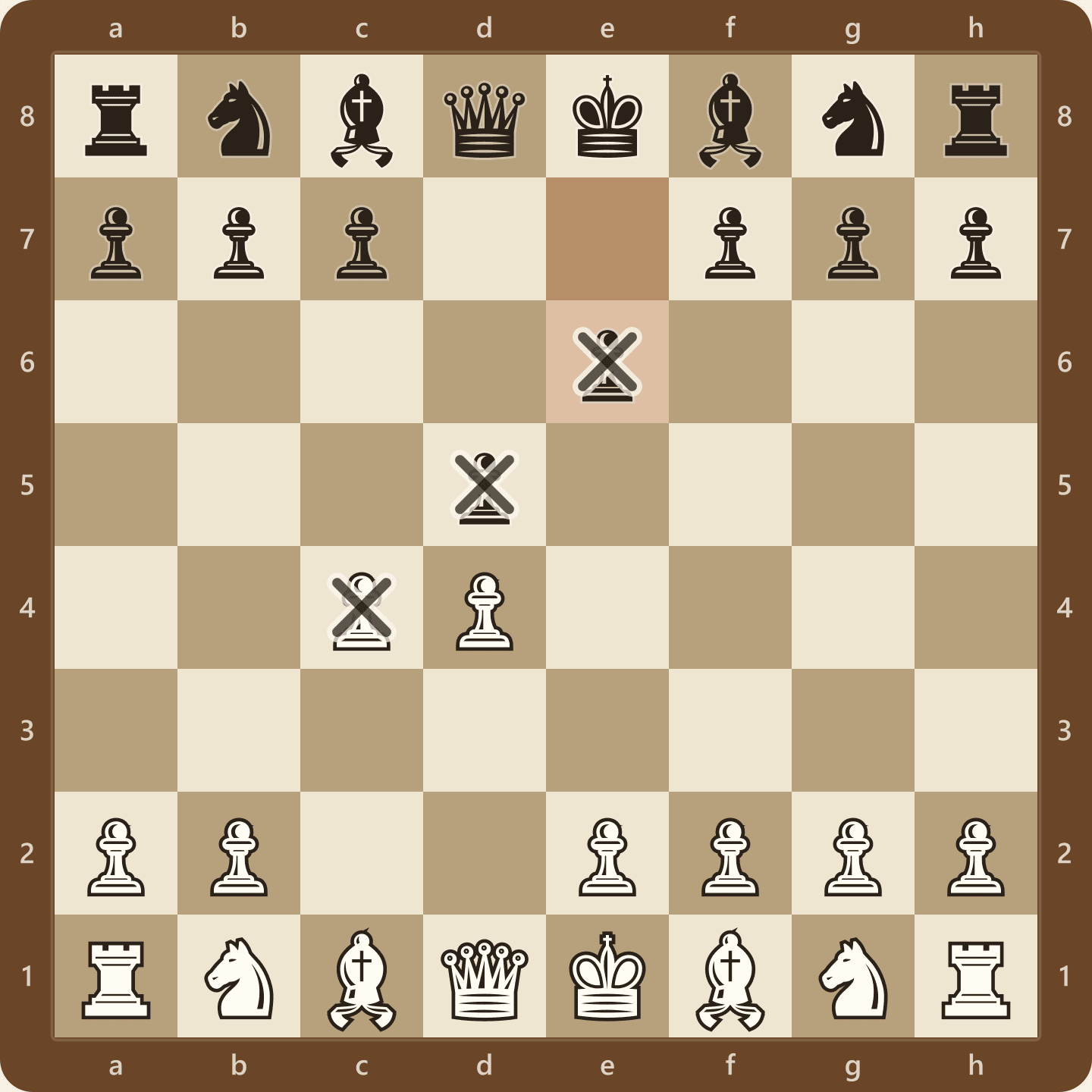
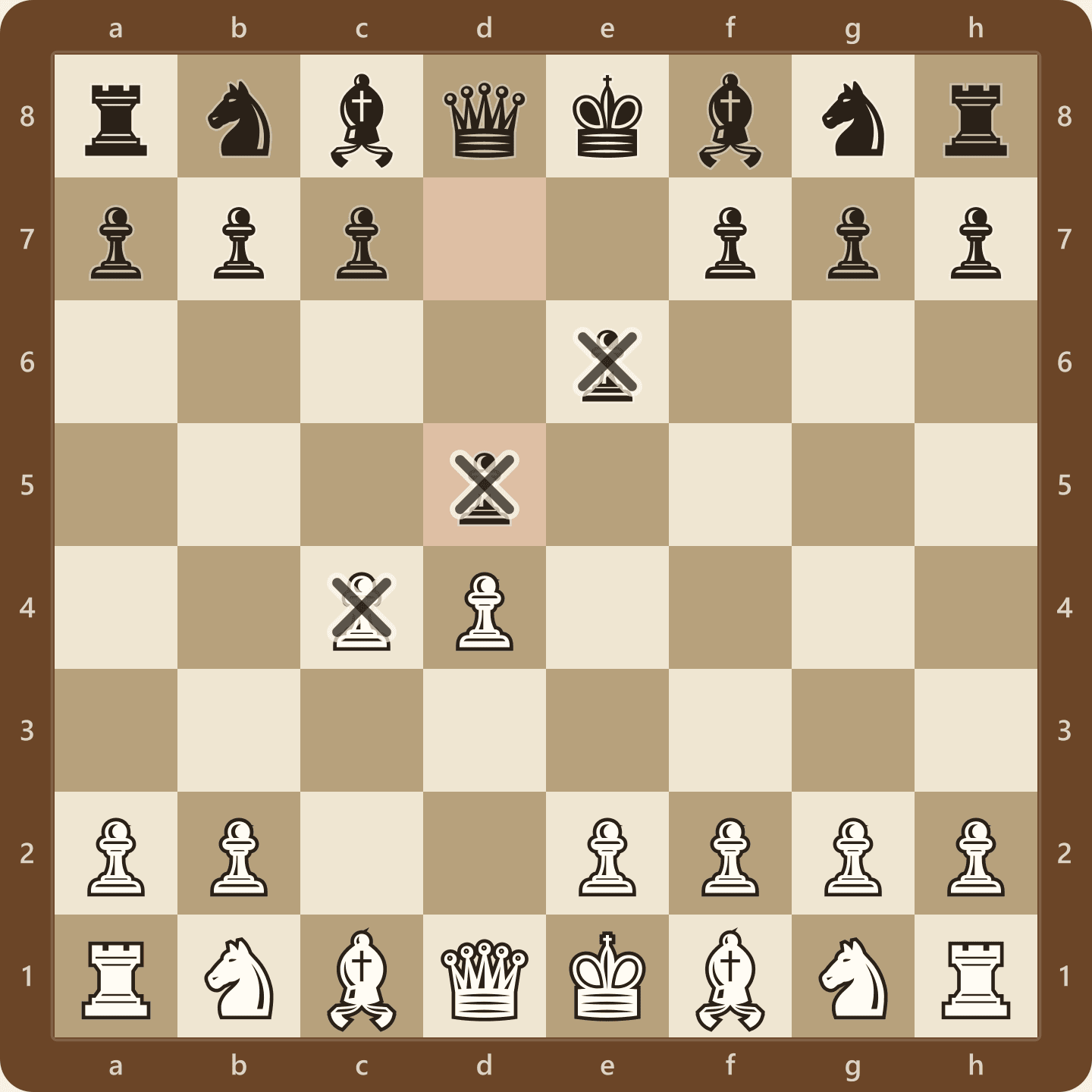
Those two diagrams are the same position. The move orders differ, the resulting board does not: both produce the identical FEN, down to the character. A transposition is when different move orders reach the same position, and chess is riddled with them.
So is that one opening or two? By ECO code, the second game passes through A10, an English Opening, before landing in a D-code. By name, players call it whichever one they were aiming for. Any count has already made an arbitrary decision about this before it reports a number.
The number that makes all the others look small
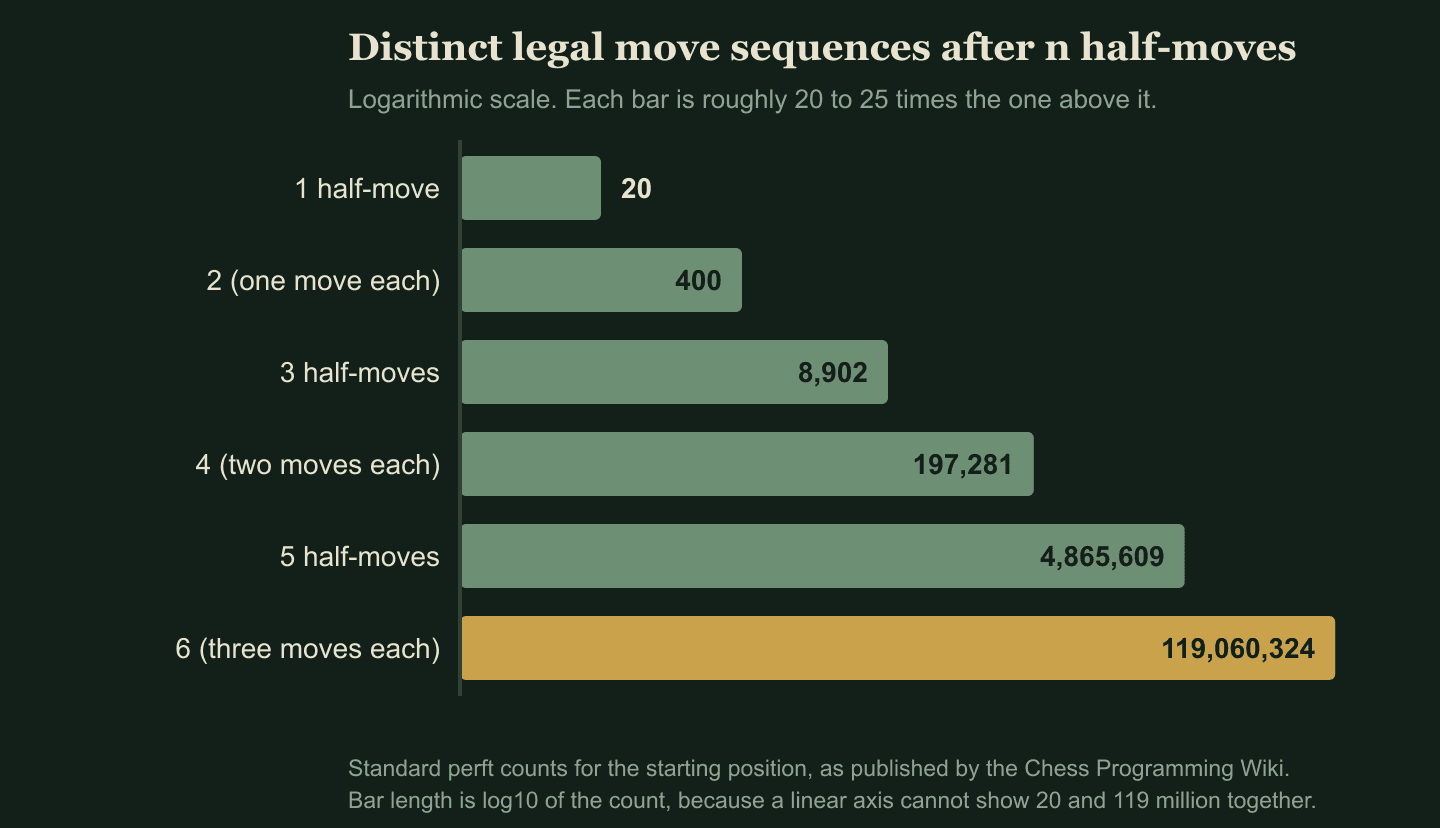
Counting distinct legal move sequences from the starting position is a solved problem in computer chess, where the figures are called perft values. The published counts go:
- 1 half-move: 20
- 2 half-moves, one move each: 400
- 3 half-moves: 8,902
- 4 half-moves, two moves each: 197,281
- 5 half-moves: 4,865,609
- 6 half-moves, three moves each: 119,060,324
Three moves each and there are already more than 119 million distinct games. Any legal-move generator reproduces those figures exactly, which is why they are used as the standard correctness test for chess engines.
Zoom all the way out and John Tromp's 2021 computation estimated the number of legal chess positions at roughly 4.8 x 10^44, later refined to (4.59 plus or minus 0.38) x 10^44 at 95% confidence. That is positions, not games, and it has more digits than there are grains of sand on Earth.
The useful takeaway is not awe. It is that 500 codes and a few thousand names are a human filing system laid over something with no natural number of parts. The names exist because players needed to talk to each other, not because chess divides that way.
How many do you actually need?
Three.
One opening as White, one reply to 1.e4, one reply to 1.d4. That covers nearly every game you will play, and until you are comfortably above 1600 a fourth line is study time you could have spent on tactics. What chess opening should you play? routes you to a specific three, and how much opening theory do you actually need? makes the longer argument.
The openings you will actually meet are a short list, not a long one. Against 1.e4 the Sicilian Defense is the most played reply at every level, followed by 1...e5 and the Caro-Kann Defense. Against 1.d4 you will see the Queen's Gambit, the London System, the King's Indian Defense and the Slav Defense over and over. That is roughly a dozen names covering the overwhelming majority of your games, out of several thousand that exist.
Frequently asked questions
How many chess openings and variations are there in total?
There is no single total, because it depends on whether you count classification codes, names, or positions. The ECO system has exactly 500 codes from A00 to E99. The Oxford Companion to Chess indexes 1,327 named variations. A full ECO-derived move database runs to 3,810 named openings and variations. The number of legal positions in chess is estimated at about 4.8 x 10^44, which no naming system will ever cover.
How many chess openings are there without counting variations?
If you count top-level families rather than every named branch, those 3,810 database entries resolve to 166 distinct families, things like Sicilian Defense, Ruy Lopez or English Opening before any colon. If you count only the openings a club player will actually meet, the honest answer is closer to twenty.
How many chess openings do I need to know?
Three lines: one first move as White, one reply to 1.e4, one reply to 1.d4. Below about 1600, depth in three lines beats breadth across ten, because your opponents leave any book you have studied within a handful of moves anyway. Adding a fourth before the first three feel automatic is the most common way improving players waste study time.
What are the ECO codes and what do the letters mean?
ECO stands for Encyclopaedia of Chess Openings, published by Chess Informant. Codes run A00 to E99, 100 per letter, 500 in total. A covers flank openings, B semi-open games (everything against 1.e4 except 1...e5 and the French), C the open games plus the French Defense, D closed and semi-closed games, E the Indian defences. A code is a bucket of related positions rather than a single line.
What are the most common chess openings?
Against 1.e4, the Sicilian Defense is the most played reply, with 1...e5 (leading to the Italian Game and the Ruy Lopez) and the Caro-Kann Defense close behind. Against 1.d4, the Queen's Gambit, the London System, the Slav Defense and the King's Indian Defense dominate. A dozen or so names cover the great majority of games at club level.
Why do the same moves sometimes have different opening names?
Transposition. Different move orders can reach exactly the same position, so the same board can belong to two different named openings depending on how you got there. 1.d4 d5 2.c4 e6 and 1.c4 e6 2.d4 d5 produce an identical position, one filed as a Queen's Gambit Declined and the other starting life as an English Opening. This is the main reason no opening count is exact.
Where to go next
- Chess openings: the complete guide maps everything named on this page.
- Chess opening names: the complete list covers where the names came from.
- Chess opening principles is what to fall back on in a position no list covers, which will be most of them.